
by Michael A. Gardiner
February 5, 2025
Aushak is the national dish of Afghanistan. I first encountered Aushak at the marvelous Afghani restaurants of Madison, Wisconsin restauranteur Ghafoor Zafari. His restaurants featured an upscale version of Afghani cuisine not easily found on our shores. It was his aushak that convinced me the food of the Middle East could be more than falafel and shawarma (though there is nothing wrong with those and quite a lot right).
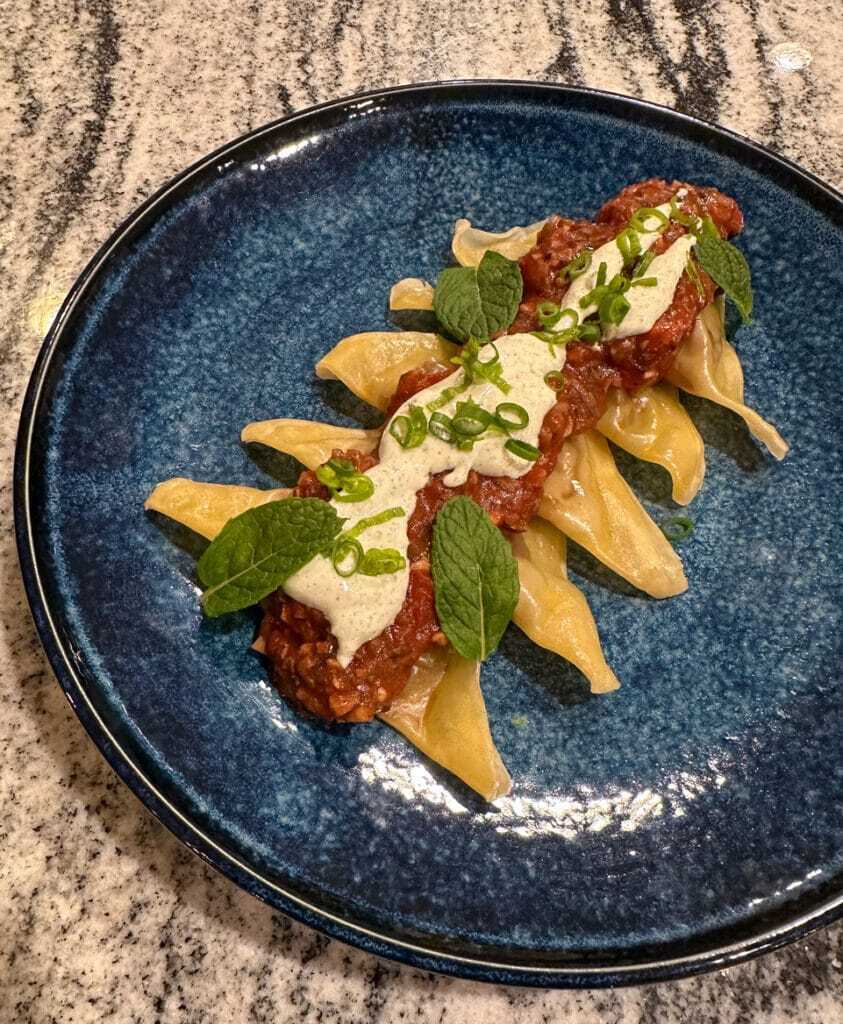
There was something at once exotic and familiar about the delicate dumplings. At one level it might be tempting to think of them as “ravioli.” After all, they are dumplings filled with sautéed leeks and are served with the familiar big, comforting flavors of Zafari’s tomato and meat ragu. But then there’s the yogurt sauce. That does not exactly fit into the ravioli paradigm. What it does, though, is offer a dose of welcome freshness. As much as each of these elements please in their own right, Aushak is very much a case of the whole being greater than the sum of its parts. And it is a whole that has as much of a place on a fine dining table as it does as street food.
Perhaps the secret to the appeal of Aushak is geographical and historical. As a major stop on the Silk Road—the ancient trade routes between Europe and China—Afghanistan necessarily reached its arms both east and west. Its culture and its food took something from both, never fully adopting either. Aushak, like many Afghani dishes, shows that heritage. Yes, aushak can remind the diner of Italian ravioli. But if this Afghani take on dumplings seems to be one part ravioli it also seems to be one part Chinese jiaozi.
This version of Aushak is one I created for a Jewish shabbat supper and thus had to be kosher. Like many Middle Eastern dishes, though, traditional aushak combines yogurt (for creaminess) with meat (for richness and savory character). That combination of meat and dairy means the dish cannot be kosher. But, by substituting a rich tomato mushroom duxelles for the ground beef of the original dish a fully kosher dairy-based dish results. While this version of aushak is certainly different than the classic—lighter, and perhaps more umami-forward—it is every bit as rich and tasty.
I also like to think my version of the dish is, in addition to being kosher, closer in style and intent to that which Zafari might have served had he been Israeli rather than Afghani: unabashedly upscale and uncompromising.
Aushak with Tomato Duxelles
Ingredients – Serves 6
- For the Tomato Duxelles:
- 2 teaspoons extra-virgin olive oil
- 1 yellow onion, finely diced
- 1 teaspoon Kosher salt
- 4 garlic cloves, minced
- 8 ounces white (or crimini) mushrooms, minced
- 1 ½ teaspoons paprika
- 1 teaspoon ground coriander
- ¼ teaspoon ground cardamom
- 1 teaspoon black pepper
- 8 ounces (about half a can) crushed tomatoes
- ¼-½ cup (or, better yet, sherry) water to thin, as needed
For the Aushak:
- 2 leeks, white parts only, cleaned and finely chopped
- ½ teaspoon red chile flakes
- 1 tablespoon extra-virgin olive oil
- Kosher Salt
- 24 square wonton wrappers
- All-purpose flour
For the Chakah (Yogurt Sauce):
- 2 cups plain Greek yogurt
- 2 cloves garlic, minced
- 1 teaspoon dried mint
- 1 teaspoon salt
For the Garnish:
- Fresh mint leaves
- 1 scallion (green onion), green parts finely chopped
Amba Sauce (recipe below)
To Make the Tomato Duxelles.
In a medium to large pot, heat the extra-virgin olive oil over medium heat. Add the onion and a pinch of salt and sauté until the onion is translucent, about 4-5 minutes. Add in the garlic, stir to combine, and continue to cook for 1-2 minutes. Add in the minced mushrooms and sauté about 2 minutes until lightly browned. Stir in the paprika, coriander, cardamom, remaining salt, and pepper. Add the crushed canned tomatoes and cook about 5 minutes until the flavors marry. Add in the water or dry sherry to deglaze the pan. Taste and adjust seasonings if needed. Cover to keep warm and set aside.
To Make the Aushak.
In small sauté pan, cook the leeks with the chile flakes in the olive oil over medium heat until the leeks are translucent, about 2 minutes. Add the salt.
Fill a small bowl with cold water. Starting with 1 wonton wrapper on a lightly floured surface. Using your index finger, swipe a ring of water around the perimeter of the circular wonton wrapper. Spoon a teaspoon of the leeks into the center of the wrapper. Fold one side of the wonton wrapper over the filling to form a triangle, pressing down around the filling carefully to force out any air. Seal the edges of the aushak by compressing them with your thumb and index finger. Repeat with the remaining wontons. As they are formed, transfer the aushak to a plate, spread a little flour between the dumplings to keep them from sticking, and cover with a dry kitchen towel, turning them occasionally.
To Make the Chakah: Combine the yogurt, garlic, and salt in the bowl of a food processor and pulse to mix. Set aside
To Cook the Aushak: In a large pot, bring 8 cups of water to a boil and add the salt and oil. Carefully drop the aushak in the water and cook until tender, about 3 minutes.
To Plate the Aushak: Plate the aushak in a line across the plate. Top line of dumplings with the tomato duxelles. Top the tomato duxelles with some of the chakah and garnish scallions, mint leaves and the Amba Sauce.
Amba (Pickled Mango) Sauce
- Makes about 1½ cups
- 1 ripe mango and 1 unripe mango (about 1½ pounds total)
- 2 large lemons
- 1½ tablespoons extra-virgin olive oil
- 2 cloves garlic, minced
- ½ teaspoon yellow mustard seeds
- ½ teaspoon fenugreek seeds
- ½ teaspoon Aleppo pepper
- ½ teaspoon Spanish smoked paprika (aka pimenton)
- ½ teaspoon ground turmeric
- ½ teaspoon ground cumin
Peel the mangos, cut the flesh of the fruit from the pit, and add it to the bowl of a food processor. Zest the lemons with a grater, reserving the fruit, and add the zest to the food processor. Pulse several times to combine, then increase the speed and process to purée, about 20 seconds.
Heat the olive oil in a small sauté pan over medium heat. When hot, add the garlic, mustard seeds, fenugreek seeds, Aleppo pepper, smoked paprika, turmeric, and cumin and cook until the garlic is lightly golden, shaking the pan occasionally, about 2 to 3 minutes. Add the puréed mango to the pan and stir to combine. Taste and adjust the seasoning by adding salt or lemon juice, as desired. Let the sauce cool, then cover, transfer to the refrigerator, and store, for up to 1 week.
Notes:
- Ingredients like fenugreek seeds and Aleppo pepper can be obtained at Middle Eastern markets such as Vine Ripe in East County or Indian markets on or around Miramar Road.
- Those stores often carry bottled Amba sauce. Some brands of the Amba are fully liquid; others require a run through a food processor or high-speed blender. The quality of the Amba is not likely to be as good as the sauce you can make at home but it still tends to be quite good and significantly easier.