Teufelsberg, Berlin—Former Listening Station and Street Art Gallery
Cornelia Feye, reporting from Berlin
June 8, 2025
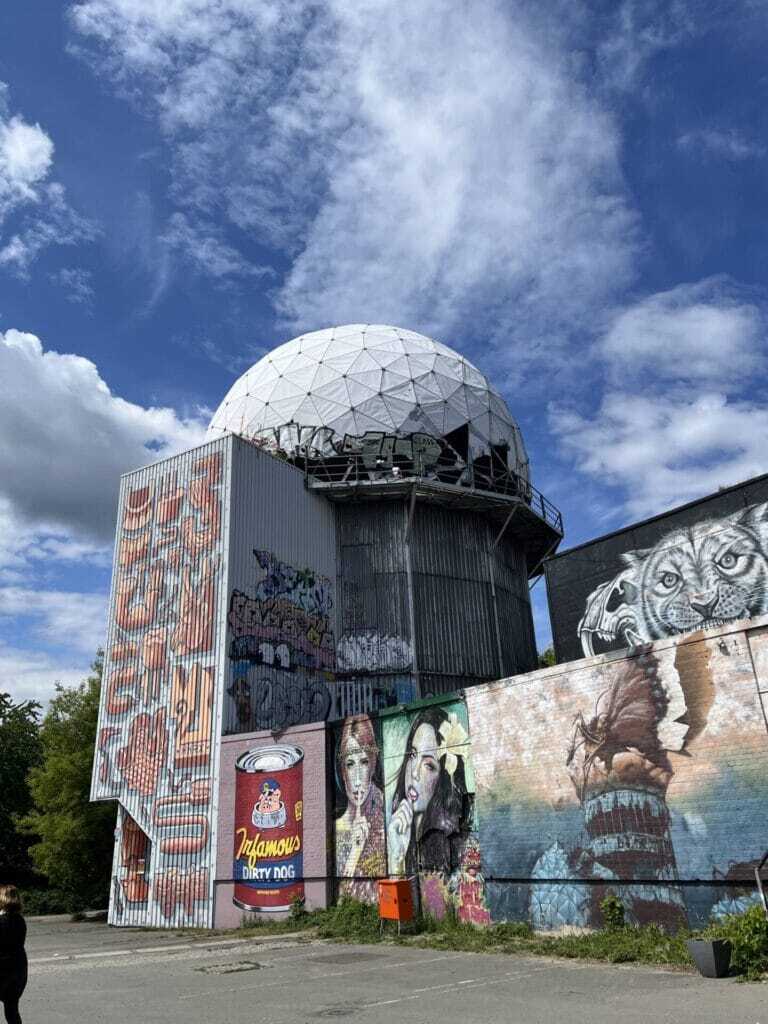
Berlin is flat as a pancake. As a San Diegan I’m used to hills and canyons. In Berlin, I never know where I am in the various neighborhoods (or Kiez, as the Berliners say), because I lack the overview. Fortunately, a non-natural mountain named Teufelsberg, or Devil’s Mountain exists. It is only 120 meters or 360 feet tall and it was created by piling up Berlin’s rubble of World War II in the years between 1950 and 1972. The Allies used it as a listening station during the Cold War, between 1963 and 1994 to intercept Stasi communications in East Berlin. This is where spies listened to spies.
The now dilapidated radar domes still dominate the skyline. After the Wall came down and East and West Germany were unified in 1989, the listening station had lost its purpose and was abandoned. By now the mountain is overgrown with dense green forest including birches, beech trees and pines. To reach the Teufelsberg, I walked through a green tunnel smelling of wet earth as sporadic sun beams filtered through the foliage. The speckled sunlight suddenly gave way to crumbling walls covered in thick layers of graffiti. Such is Berlin—nature next to ruins covered with paint. On top of Teufelsberg, next to the shredded radar domes, I finally got my overview. 360 degrees of Berlin skyline. The Fernsehturm / TV tower on Alexanderplatz and the Funkturm / Broadcasting Tower in Charlottenburg-Wilmersdorf are still the highest landmarks. No real skyscrapers here, but instead miles and miles of green space, forests, and parks. The acres and acres of trees and lakes make Berlin’s intensity manageable.
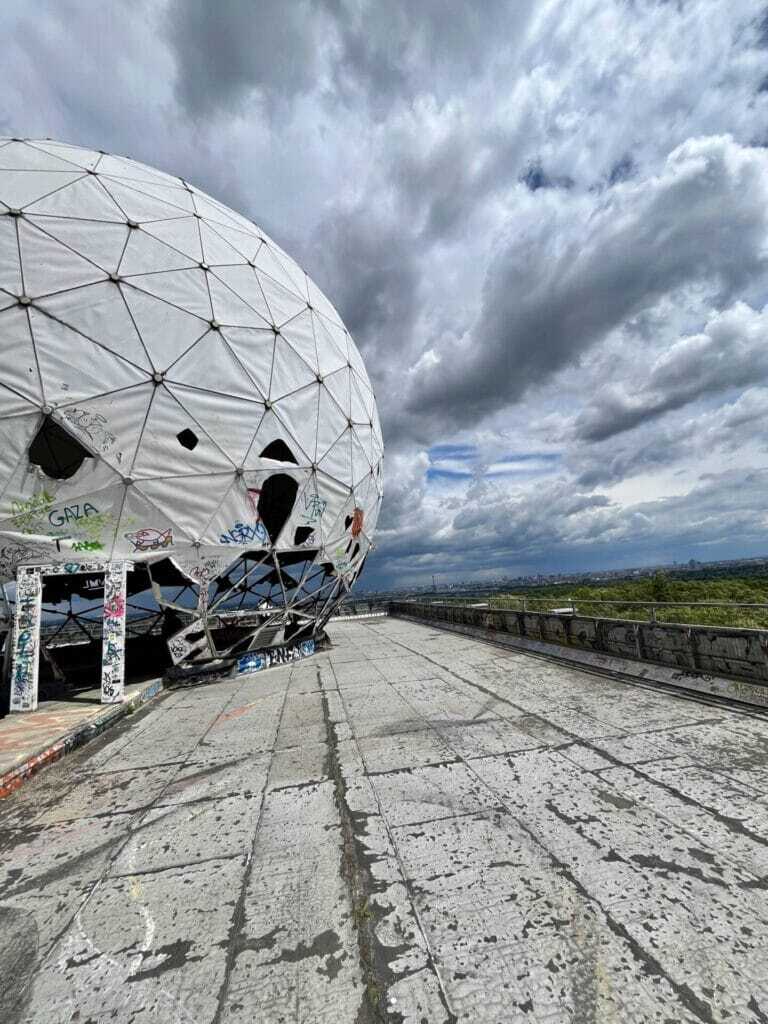
The Teufelsberg, in its faded glory has a typical Berliner apocalyptic, rough charm. I could imagine huddling here after a disaster. The wind beat around me with such fervor that the flaps of the white domes rattled ominously and whipped loose sand into small dust devils – maybe that’s where the name of the mountain came from. The sky loomed in dramatic gray clouds overhead, punctured momentarily by pale, weak sunbeams. A slogan spray painted on the enclosing wall of the viewing platform reads: Der Unterschied, der uns vereint / The Difference that unites us, referring to diversity as a unifying factor.
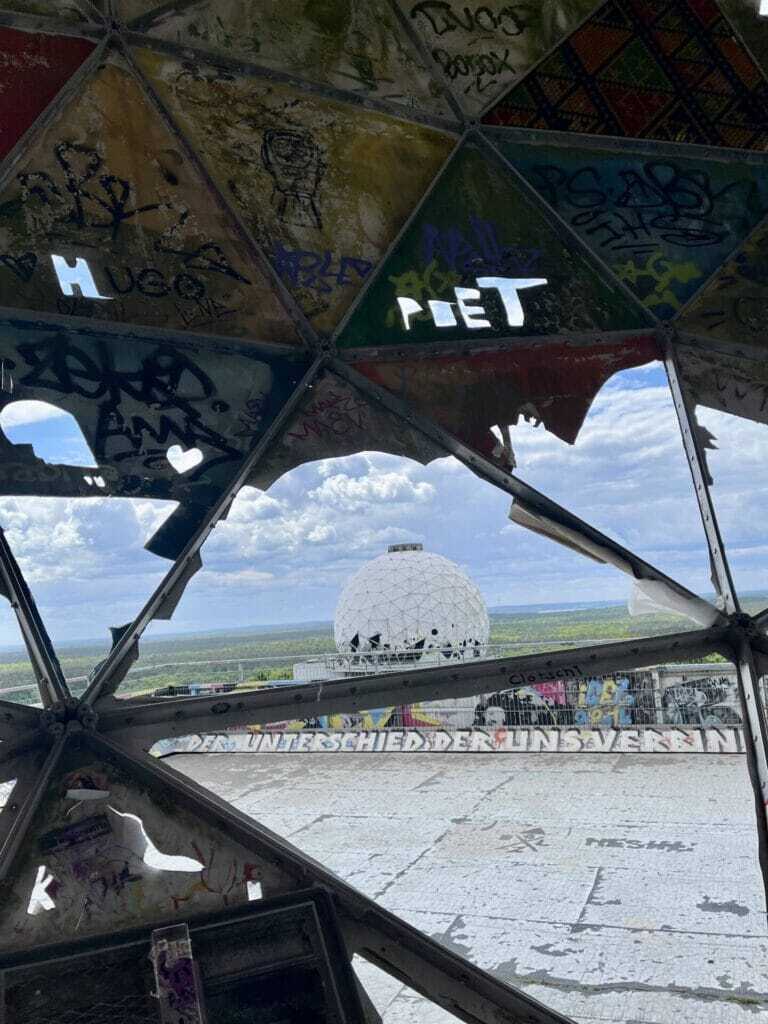
The dramatic setting of Teufelsberg houses one of Europe’s largest open air street art galleries. The abandoned concrete spaces, formerly occupied by spies and surveillance specialist, now house enormous murals by street artists. They are not graffiti, but changing, skillful artworks created by the international street art scene, telling stories or addressing current events.
Coming up on the many steps leading to the viewing platform, a quadriga of murals greets the visitor. A giant black and white tiger seems to jump over the lower building next to a former radar tower. Two young girls put their fingers on their lips as if to warn the visitors: Be careful what you say, someone is listening. But the central mural shows a huge butterfly landing on the roof of a radar dome devouring the building. The theme of soft power overcoming the powers of war—in this case the Cold War listening towers— is a common theme in the murals on Teufelsberg.

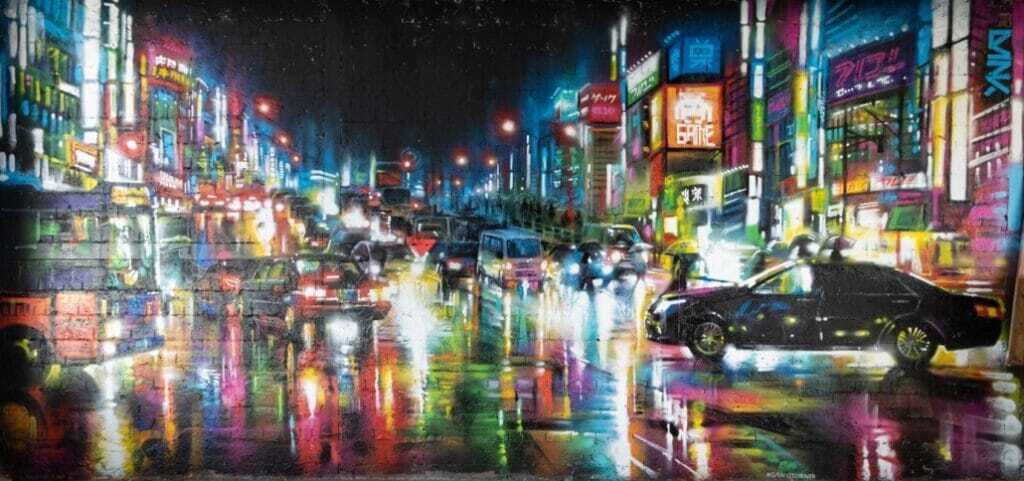
Inside the raw, open spaces of the street art Gallery, I found a piece of Tokyo in Berlin. The mural by the British Street Artist Dan Kitchener aka DANK, depicts a rain-soaked street illuminated by vibrant neon lights. The inspiration for this scene came from DANK’s nighttime strolls through Tokyo, where he photographed the streets in pouring rain to capture the perfect mood and perspective. He translated these impressions into his dynamic, colorful, modern-impressionist style image on Teufelsberg.
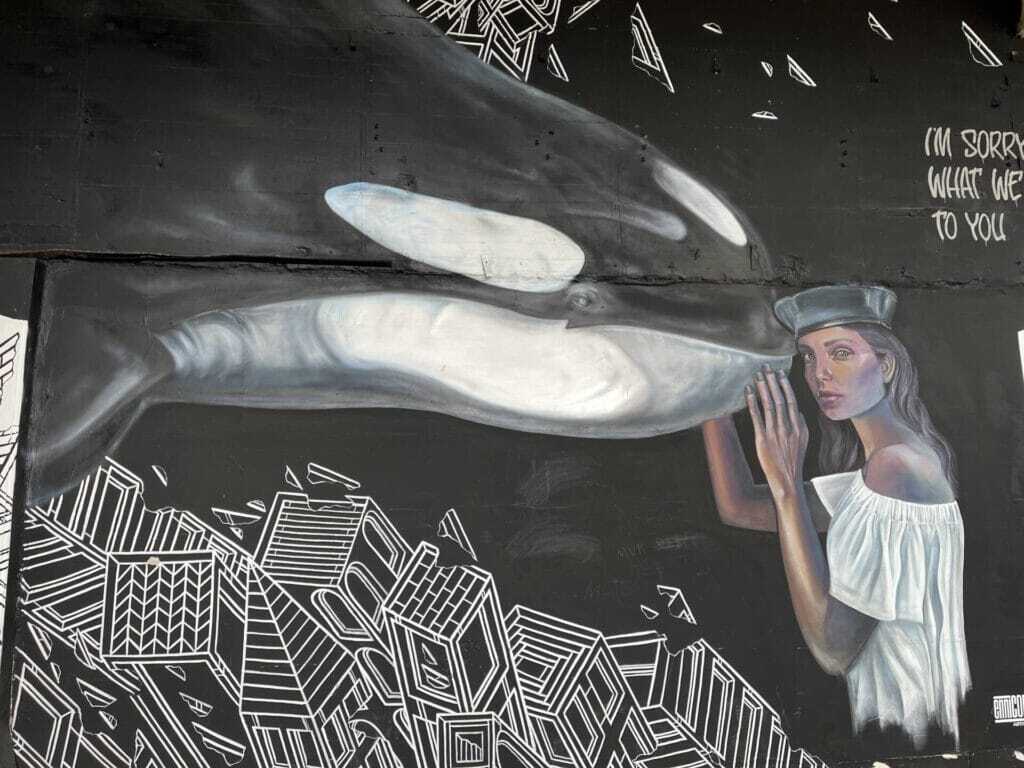
Not far from Kitchener’s work a mural by the artist duo ENNICOLOR shows a girl caressing a large orca whale. The caption reads, “I’m sorry for what we have done to you”. ENNICOLOR explain painting the entire background black, symbolizing the darkness of captive orcas. The protective figure of the woman can be perceived as either showing compassion, or being a sailor, who takes part in the industry capturing orcas. The orca is close to life size, which amplifies the impact of this mural.
German street artist Maximilian Prantl, aka HRNX, created the mural of the Infamous Dirty Dog. One entire wall depicts all the body parts and processes going into creating a sausage. On the wall beside it, a can presents the completed product of the ‘infamous dirty dog’. The red cover features a pig’s face sticking out of a dirty dish. The combination of images makes the sausage appear very unappetizing.
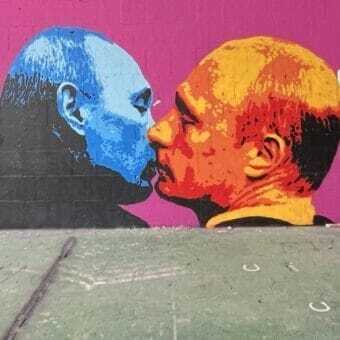
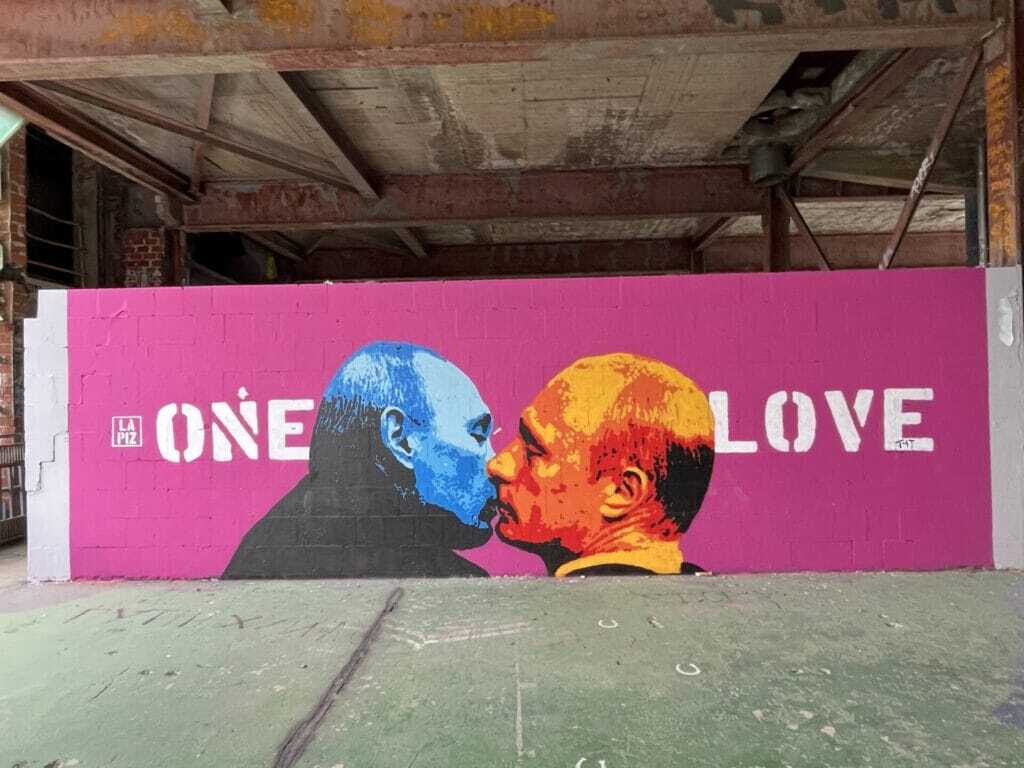
LAPIZ, a self-taught street artist from Berlin has painted One Love of Putin kissing himself. A symbol of unbridled self-love and self-absorption of the Russian leader. Here in Berlin the threat of Putin’s expansionism is felt very clearly. Russia is not far away.
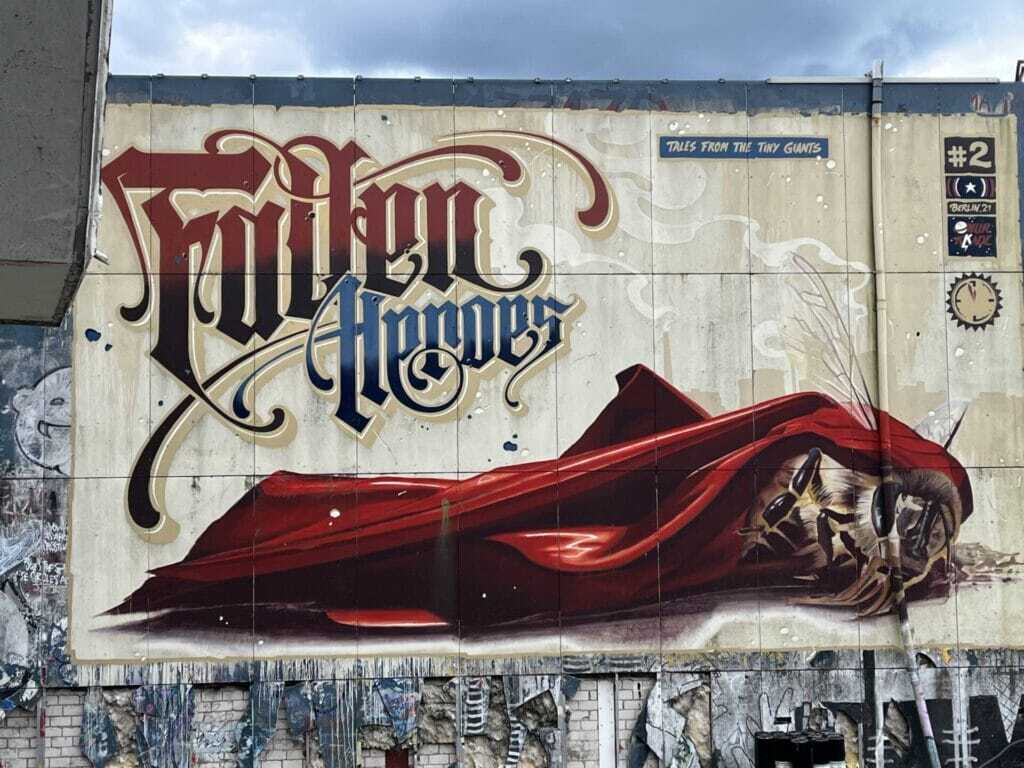
In Tales from the Tiny Giants by Berlin 21, an organization with sustainability and environmental goals, a giant bee has fallen. The Caption reads Fallen Heroes, and the red cape partially covering the bee symbolizes her heroic battle. Her transparent wings protrude through the cape, and a pipe serves as her long tongue through which she drinks the nectar. A small clock above the bee’s head shows it’s five minutes to twelve. The environmental clock is ticking, and time is running out. Bees have been dying in alarming numbers due to pesticides and disappearing habitat. Seeing the fuzzy body of a bee enlarged a hundredfold, makes this mural especially powerful.
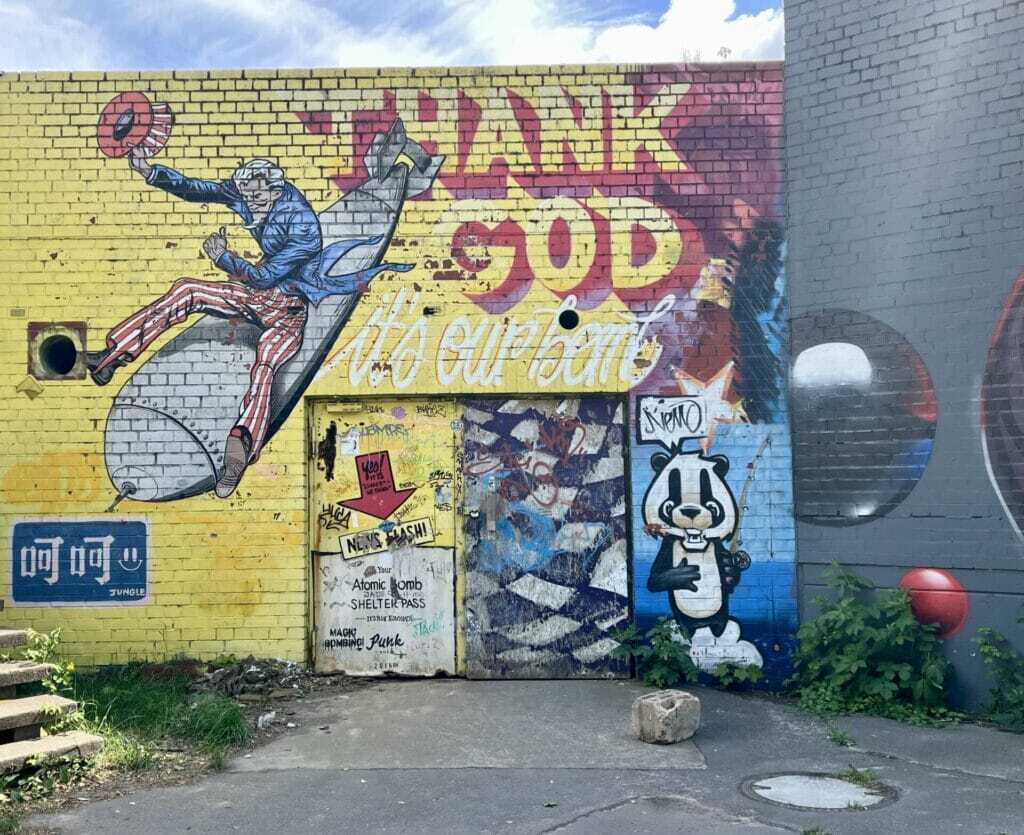
Thank God it’s our Bomb, by Magic Bombing, MG, shows Uncle Sam riding on an atomic missile with a devilish grin on his face. He waves his red and white striped hat in the air. The irony is not lost on the viewer that any nuclear bomb is fatal, whether it is “ours” or not. The arrow points at a note inscribed with: Your Atomic bomb Shelter Pass; subtitle: It’s big enough. But the door doesn’t look big and it certainly doesn’t look safe.
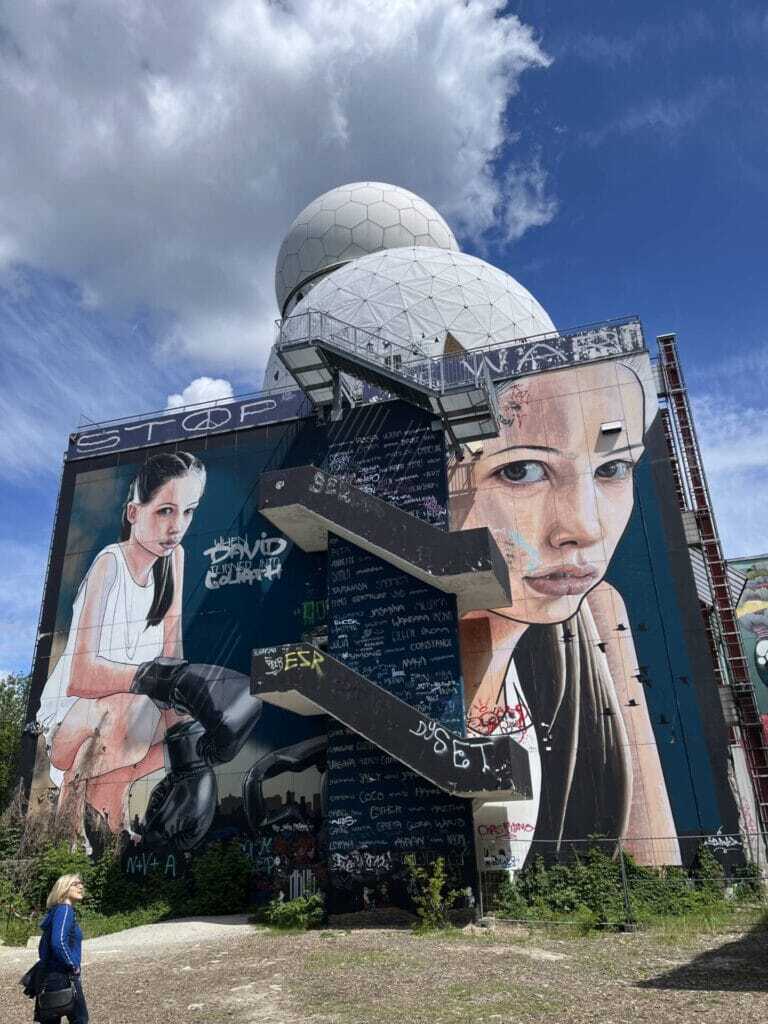
Finally, the mural When David turns into Goliath by AKUT, covers two walls of a huge building. On the left, a sweet-looking girl with a dark ponytail and a white shirtless dress wears boxing gloves and looks at the viewer appraisingly. Her size is already at least five-times as big as a human. But on the right side of the staircase, she is even more gigantic, her face alone is three-times human size. At those dimensions, her look appears threatening. She could easily squash a person with one hit of her boxing glove. I love how this mural makes good use of the dimensions of a looming building wall to get it’s point across: that small David—in this case in the form of a young, innocent looking girl—can become very powerful.
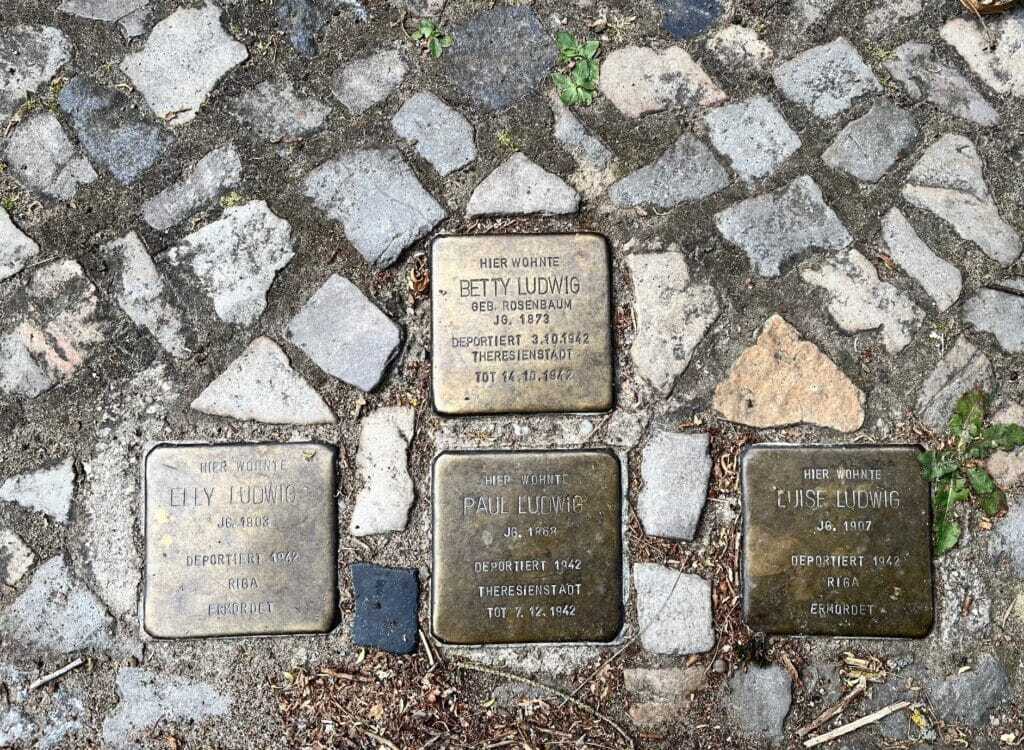
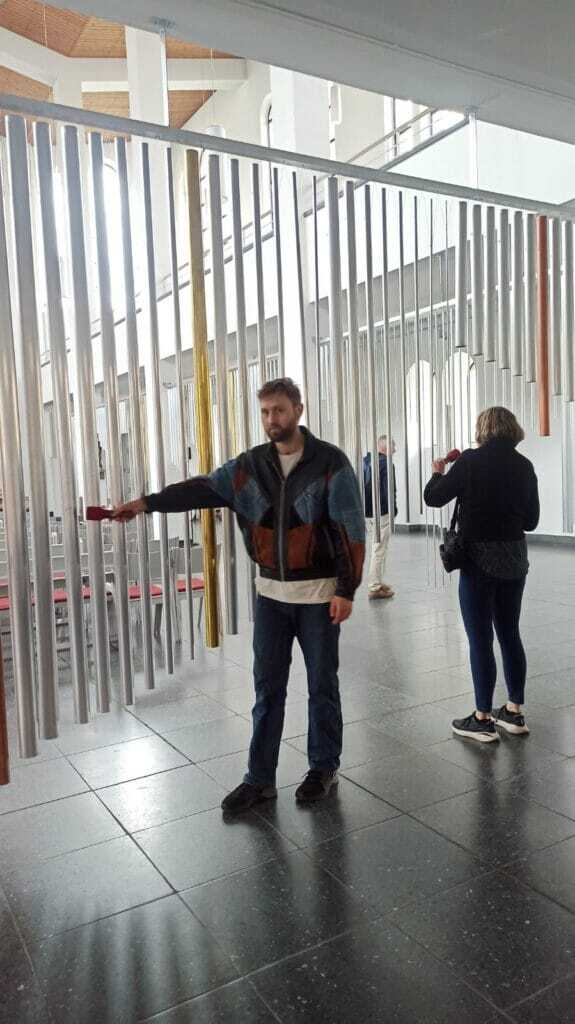
What I love about Berlin, is that art and history are all around, in unexpected places like an old radar listening station on top of a hill made of rubble, or just walking along the street, where plaques commemorate the houses where Jewish families were arrested and deported, or in a church which featured a free sound installation. I’ll eventually come back to California, but right now I’m happy to spend two more months in captivating Berlin.