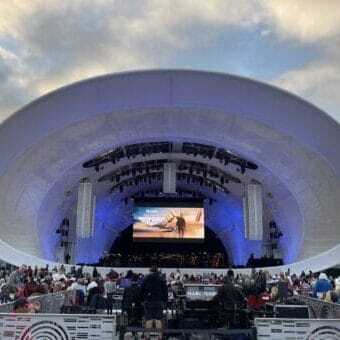
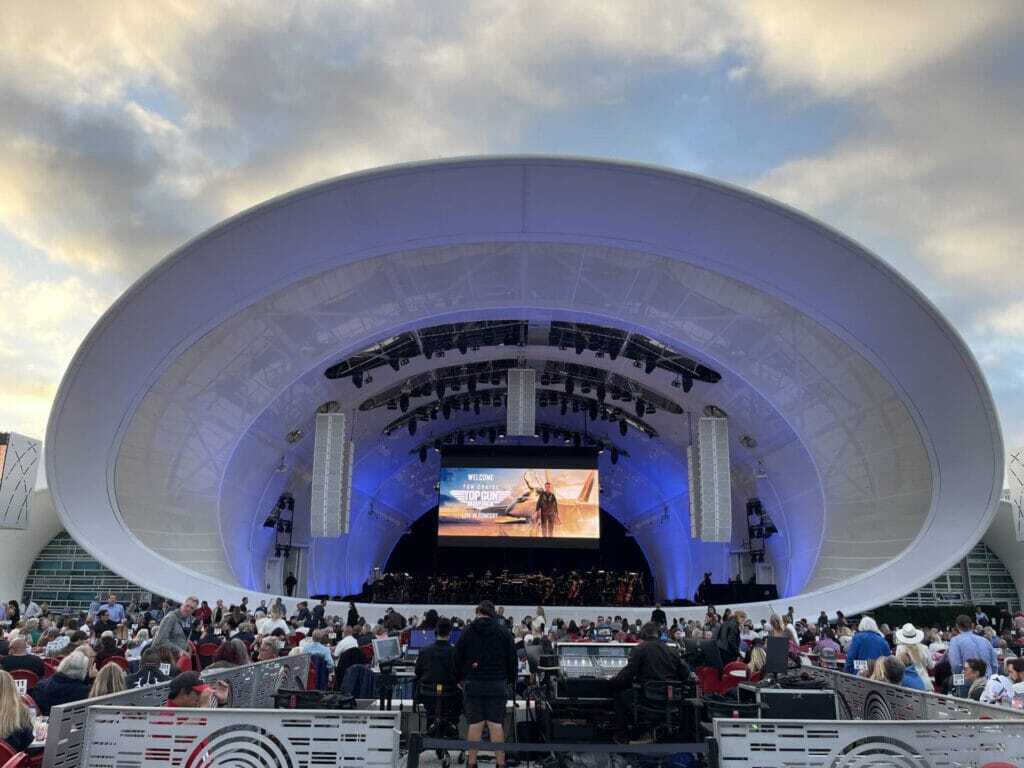
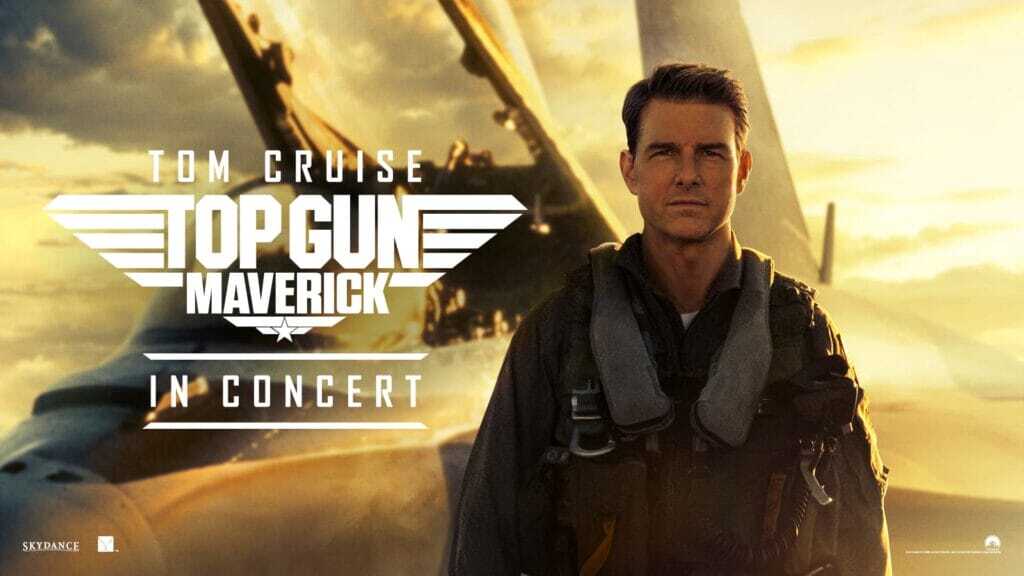
Movies at the symphony are always a good time and a great start of San Diego summer. While the Shell’s summer season began at the start of the month, there was plenty of cheering, wooing, and at times a little too much extracurricular commentary at the Rady Shell on Friday July 11, as the symphony performed Top Gun: Maverick, their first film this summer.
Top Gun: Maverick at the Shell was befitting. After all, it was filmed in and around San Diego. In fact, several scenes were shot either across the bay in Coronado, at Naval Air Station North Island; in Point Loma, at Fort Rosecrans National Cemetery; or across the street, in a flashback scene, at the Kansas City Barbecue that nearly burned down in 2008.
Setting the Stage
As usual, the show started right on time at 7:30 pm. But there was a twist: an unexpected opening video message from Tom Cruise, the film’s executive producer and star. In it, he provided a brief history of film, film scores, and of course, a thank you to those who played a part in making the music possible.
In the future, it might be helpful if the screen or symphony indicated there was a video message that kicked off the performance or gave a cue to let everyone know something was coming.
There was a brass riff to tell everyone to get to their seats. But perhaps the aural equivalent to the lights dimming at the theater would be appropriate since folks were still chatting at the start of Cruise’s video message. It felt like being back in school when class started and everyone was still talking, but the teacher began their lecture, regardless.
Still, in that brief film history lesson, Cruise mentioned the importance of leitmotifs (pronounced LIGHT-moh-teefs). “Leitmotifs are the recurring themes throughout a musical or literary composition associated with a particular person, idea or situation,” as Cruise put it. “The use of leitmotifs redefined cinematic storytelling, and large symphony orchestras became a necessity.”
As soon as the video faded to black, the symphony kicked things off and we all got the first taste of a leitmotif. The chimes, strings, percussion, and electric guitar really shone in those first few minutes, as the opening sequence and title card made their way onto the screen. Each note brought a sense of nostalgia.
Music. Notes.
There were at least two clear moments where the music playing in the film drowned out the symphony and the score, both during montage sequences. The first time, Kenny Loggins’ “Danger Zone” broke into the opening sequence to jumpstart the montage of planes taking off from an aircraft carrier. This was a somewhat abrupt cut from one moment of nostalgia to another one.
The second time was during the sequence and montage where they were doing their first dogfighting training exercise. The Who’s “We Don’t Get Fooled Again” blasted through the sound system, which made it hard to appreciate the score. These audio issues were likely due to the sound mixing of the film.
Despite these sonic shortcomings, the score soared and the skill of the symphony on stage shone during the film’s key moments, as expected.
For instance, the first time Cruise appeared on screen with his leitmotif and the sequence that immediately followed, “Darkstar,” as his character prepared to go Mach 10 in an experimental aircraft (10 times the speed of sound, which is technically not possible yet. For reference, a commercial jet travels at around Mach 0.8, while the Concorde reached Mach 2).
It was in “Darkstar” where the symphony and score were at their best. The score snuck up on you. Yet, it was a sublime, if not majestic, experience. There was something oddly inspirational and aspirational about the hypersonic sequence and the accompaniment.
Seeing Cruise reach for something that, at this moment, is physically impossible (in the most literal sense), it was reminiscent of those quintessentially American junctures where we sought to put a man on the moon, reached for the stars, and dared to dream. The music highlighted that risk vs. reward moment.
During the sailing sequence, where the Cruise and Jennifer Connelly romance storyline progresses, the strings and brass hit that romantic leitmotif, which had a distinct Lady Gaga quality to it. Superb.
But it was toward the end of that romantic sequence where the symphony’s arrangement surpassed the score. The piano used in the live performance perfectly captured the subtlety, tenderness, and vulnerability of that moment and made it exponentially better than the film version.
Maverick’s test run, the steep climb sequence in particular, beautifully captured the moment. Then there were all the dogfighting scenes in the second half of the film, all of them flawlessly executed. And the final leitmotif as they landed the stolen F-14. Masterful. Even among the brass and the rising of the strings, the mallet instruments were still discernible.
Final Notes
At the end of the evening, the credits are where the symphony can dazzle everyone one last time. As the film visuals disappeared and the credits started rolling, the audience could focus on the score and the symphony showed off their skill with the closing medley.
The guitar solo, literally, stole the spotlight and crushed it. And without any visuals to need sound mixing, elements that might have gone unnoticed earlier, like the shakers, emerged.
Partaking in movies at the symphony is always a treat. The humor and the jokes landed harder, even in scenes with minimal dialogue, like the diner scene. The “wooing” and cheers in moments of triumph or recognition, like when Cruise gets sent back to Naval Station North Island with the flyover aerial shot of Point Loma and the San Diego Bay. The silence and tension were palpable, even at the symphony—especially with a masterful score, like this one, that knew when and how to leverage silence.
Almost everyone in attendance had seen the film and they decided to experience it again, in a different way. Yet, somehow, in this new setting, after there were no surprises left, the movie-going experience took on a new meaning. I cannot recommend these performances highly enough.
If Fast Times at Ridgemont High is the note passed between classmates about San Diego, and Anchorman is the class clown. Then Top Gun: Maverick is the love letter to this military town and the armed forces, delivered via airmail.