By Cornelia Feye
June 20, 2024
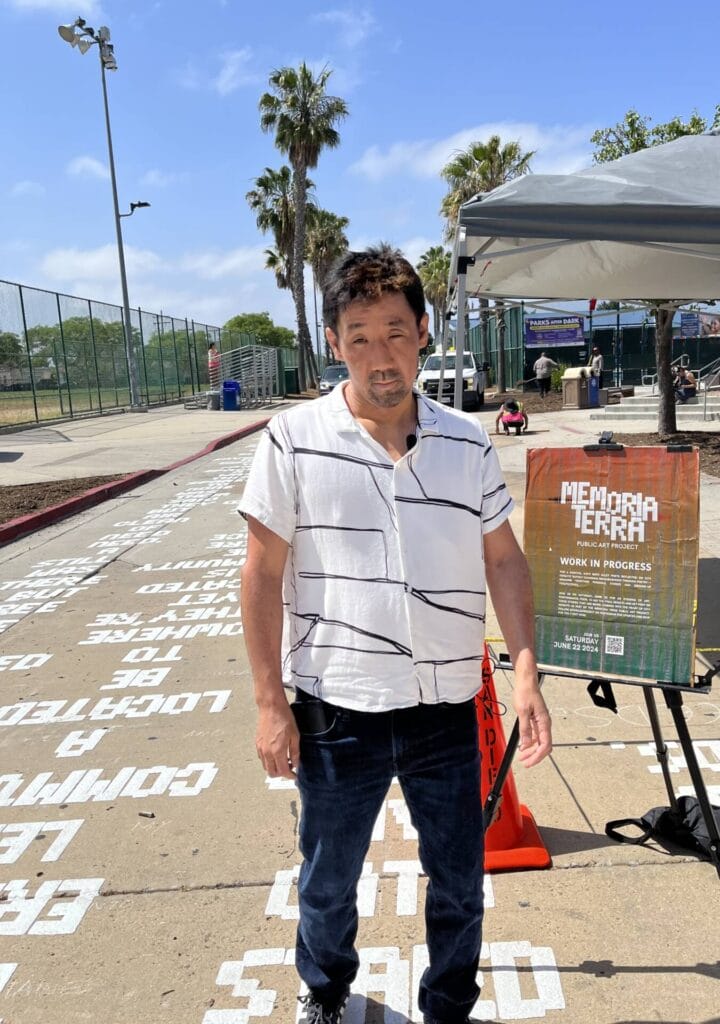
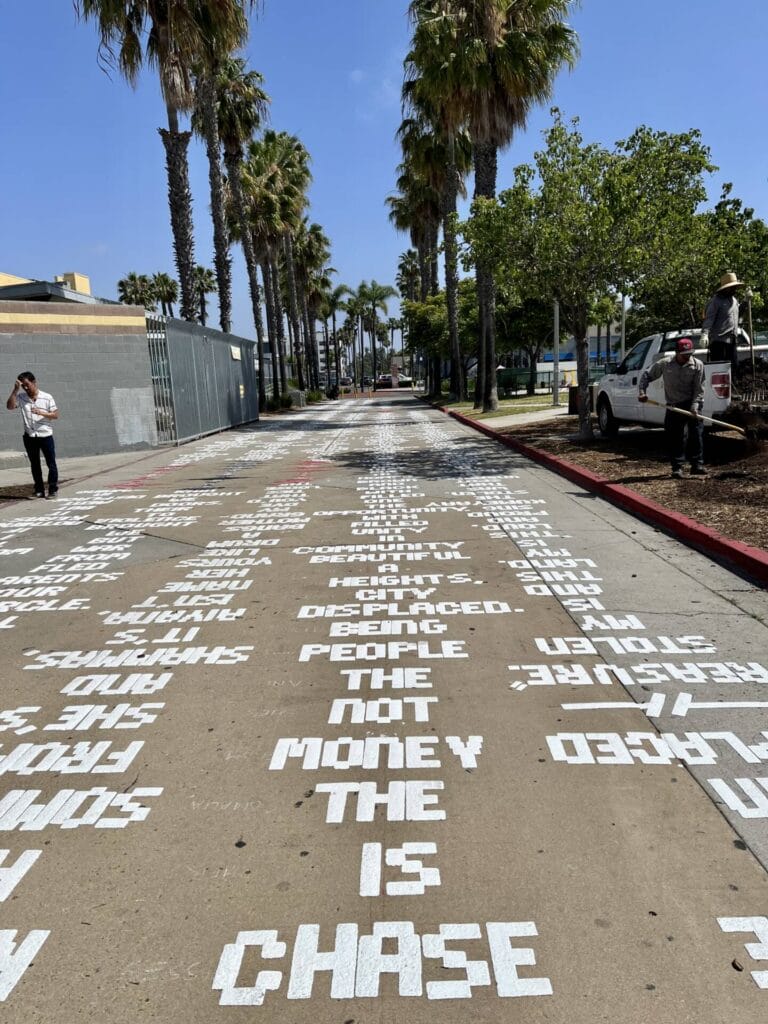
Words cover a long alley way in the heart of City Heights. The surface of the street has been transformed into a giant poetry installation. Lines of poetry, one word at a time, run the length of a city block. Japanese artist Shinpei Takeda likes working with words. Words as visual expression of ideas; words as markers of memory.
For Memoria Terra, a collaboration with Back Alley Poetry Club, five young, second-generation Cambodian, Somalian, and African American immigrants met for a year every Wednesday for dinner and a poetry workshop. The result are their stories, told through poetry, about the changing landscape of the place their families arrived in. In Memoria Terra, Takeda covered the asphalt next to the Rec Center in City Heights with their poems. The earth will hold these memories for the public and a growing group of children to read as they come to play at the park.
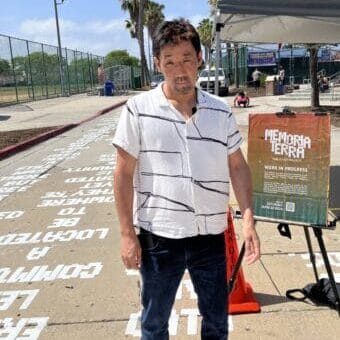
Takeda, who has exhibitions at the Kunstpalast Düsseldorf and the Kunstviertel in Vienna to his credit, used strips of white hand-cut pavement markers to form the words of the poems in five long lines filling up the entire alley surface. The specific words and shapes were literally burned onto the asphalt with flame throwers, similar to the white markings of dividing lines, making them permanent for up to ten years.
“The letters are constructed out of square and rectangular strips and pieced together like Lego pieces,” says Takeda. All 20.000 characters. It took over three weeks to put all the words in place.
Shinpai Takeda chose to live in San Diego because of its international border with Mexico and because it is a diverse community with members from many nationalities.
He is the co-founder and executive artistic director of the AjA Project, started in 2000. It serves as a compassionate space for young people, activists, visual artists and educators to engage critically with issues that affect our community. AJA stands for Autoficiencia Juntada con Apoyo (Auto-efficiency joined with support). Takeda is also a filmmaker and uses participatory storytelling and the documentary arts to tell stories of young people in the community.
“The media usually looks from the outside at young people with immigration backgrounds. We want to look from the inside out, hearing their own stories,” Takeda says.
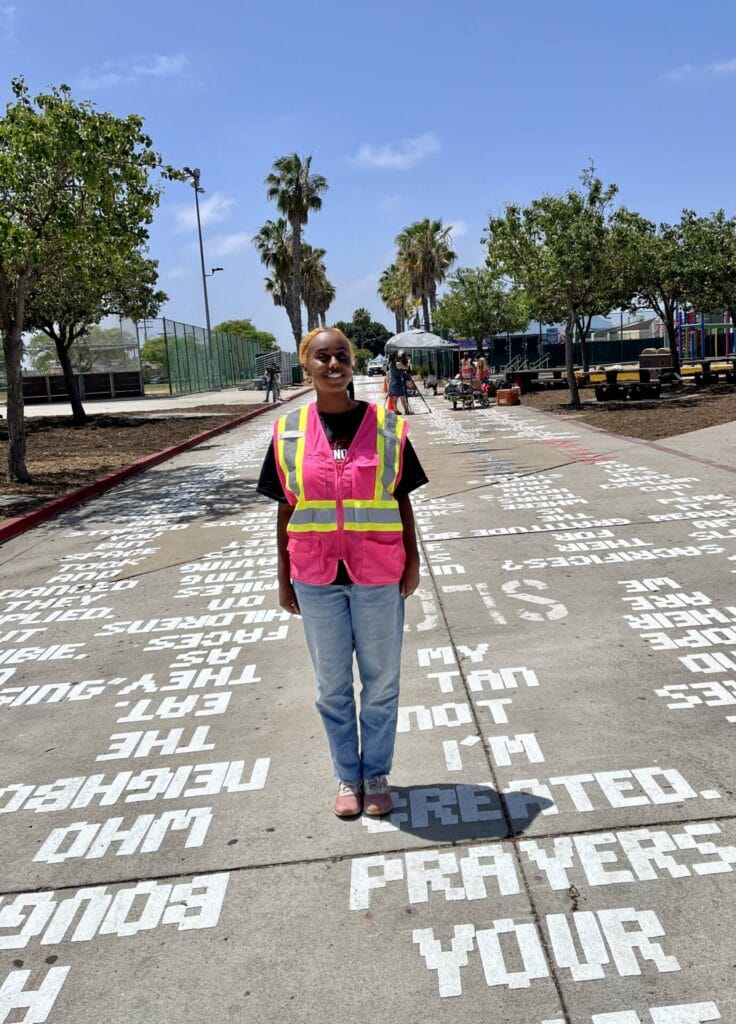
One of the young poets is Samira Hassan. She’s 19 years old and her parents are from Somalia. She’s been writing poems since she was in 3rd grade and when she heard about the Back Alley Poetry Club from a friend, she submitted one of her poems. In Land Displacement she remembers the Kumeyaay people who once populated this land from the desert to the mountains. They were displaced by Spanish colonization. Samira feels that in her community of City Heights the black and brown people are now being displaced by gentrification.
Her poem begins with an homage to the Kumeyaay:
Your spirits still lay in the streets I walk around.
It’s what makes the air fresh and the grass green.
We still dance to the sight of the moon and stars hoping your spirits hear us (…)
Can you hear me? I hope my existence is what your prayers created.
I’m not tan, my skin is the color of the Black Berries you’d eat
My hair is curly like the loose ties that you’d dye
My grandmothers bang a drum like yours
Her name isn’t Aiyana it’s Shammas and she’s from Somalia
her kisses are stained onto my cheeks and it’s what I cherish when she’s away. (…)
In the poem Samira remembers her grandmother Shammas and compares her to an indigenous woman, Aiyana:
“I’m grateful to be part of this project here in my childhood park, where I used to roller blade down this alley when I was young,” she says. Through her poem as part of Memoria Terra “I get to leave a part of me here for the next ten years.”
Open invitation to the public to attend the unveiling of the completed installation on Saturday, June 22 from 5 p.m. – 8 p.m. It will be on view permanently and open to the public at 44th Street between Wightman St. and Landis St. in City Heights, right next to the City Heights Park.