By Cory Jones
August 27, 2024
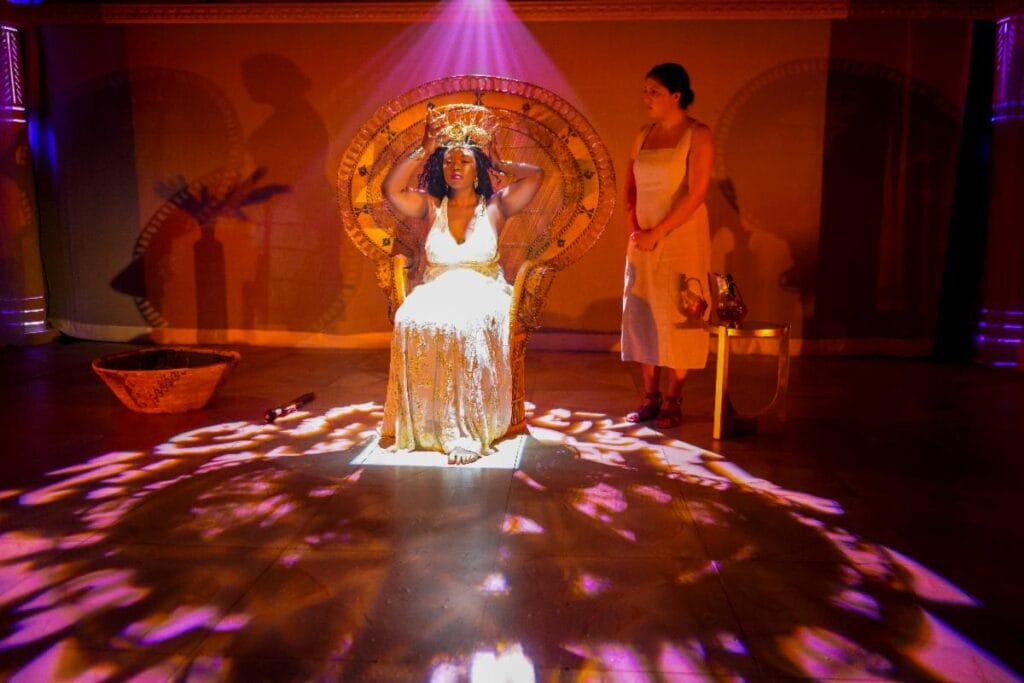
Moxie Theater in central San Diego is known locally for producing intelligent and intricately developed theatrical performances. Their current production of Cleopatra is another take on a multi-faceted historical character nuanced in both historical data as well as re-interpreted fictional interpretations of the spurious information that remains of the life and times of Julius Ceasar, Marc Antony, the triumvirate leadership of ancient Rome and a fateful love-affair. The love affair was most notably elocuted in William Shakespeare 1706 play, Antony and Cleopatra.
Cleopatra. A very old name indeed. But one that carries much weight in theatrical and dramaturgical circles and sometimes in historical political circles as well. The role was once notably portrayed on screen by the Diva’s diva, Elizabeth Taylor. Of course, Taylor’s performance was for a production written and directed by famed Hollywood producer Joseph L. Mankiewicz. And that role was the first to pay a white female actor $1 million for a role, which she notably thereafter became one of the most iconic actresses known to Hollywood. An actress that received the royal label Dame, whereas Shakespeare himself received no such honors from the royal courts in his lifetime.
The Cleopatra film was based on various histories from Plutarch, Suetonius, and Appian, as compiled by Carlo Maria Franzero in 1957. It did go on to become the highest-grossing film of 1963, earning $ 57.7 M in the US and Canada even though it lost money due to it’s marketing budget of $44 million (now valued equivalent to $438 millions in 2023 US dollars)[1]. It also combined dramatic versions of the life and times of many of the powerful Romans of the day as told by William Shakespeare.
The making of that 1963 picture required considerable heartache to produce. The original point person, Walter Wanger spent four months in prison in the “Castaic Honor Farm,” north of LA, for shooting his wife’s, Joan Bennett’s agent/lover, Jennings Lang. Wanger dreamed of making the film during his undergraduate classics studies at Dartmouth College. It took a series of directors and proposals to a number of studios to produce the epic film starring Elizabeth Taylor in a role that won eight academy awards for the film. Charlton Heston directed and starred as Antony in a direct reading film of that writer’s Antony and Cleopatra play only nine years later in 1972. It seems there are new versions of the story that are continuously created.
San Diego audiences are quite lucky to have an amazing new adaptation written and directed by the talented Joy Yvonne Jones, who also wrote a new version of the story for the production currently showing at the MOXIE Theater in Rolando through September 7th. It is a show packed with politics, love, lust, drama, Egypt, and, of course, Italy.
One of the exciting aspects of this re-telling, is that it is told from the reflections of a beautiful, strong, intelligent local San Diego actor providing her audience the tale from a female African American perspective, a perspective that is often over-shadowed by the power structures of our world.
Of course, it’s great that the Moxie took on this show since 100% of plays produced at Moxie are written by women+. 50%+ of all Artistic & Technical positions at MOXIE are given to BIPOC Theatre Makers. The “Women+” is a term the Moxie uses to indicate that they center women, and are also welcoming of other groups that are underrepresented or face gender-based biases, like Trans, non-binary, gender non-conforming, and all gender-expansive people. In preparation of the current show, the team at the Moxie coordinated with another theater group, the Loud Fridge, to provide additional critique and input from additional viewpoints. Loud Fridge Theatre Group is committed to using the performing arts to make “NOISE” in the San Diego theatre community, by nurturing inclusive collaboration on- and off-stage, by “uplifting local artists both creatively and financially, by creating accessible theatrical experiences for all people, and by embracing interdisciplinary creativity to tell stories that are bold, honest, and diverse.”
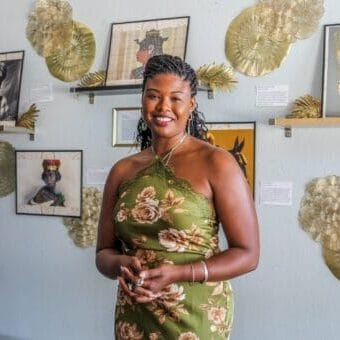
I had a chance to chat briefly with the star of the show, Joy Yvonne Jones, just before a production this past week and here’s a little inside scoop on this new epic – showing now through September 8, 2024.
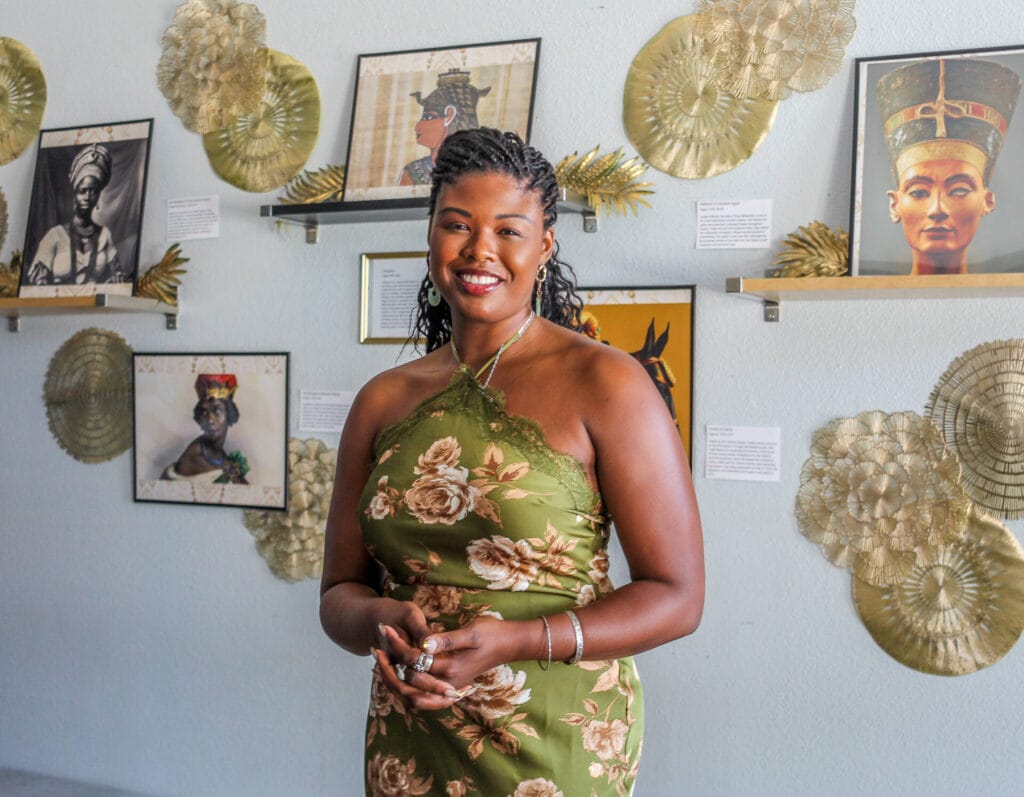
Cory Jones (CJ): How did is the relationship with Loud Fridge Theatre Group and Moxie affect the production of this show?
Joy Yvonne Jones (Joy): For the most part, since we are in the Moxie, Vanessa Duron, who is the Moxie’s Associate Artistic Director, was associate director of [Cleopatra], with Andréa Agosto as director. Moxie had a heavy hand to guide the show and during “tech,” Loud Fridge came in and [provided critical] notes and were here to guide the final pieces for the production.
CJ: One of the things that fascinated me was the use of the short video snippets in the play. It was a great way to bring in some more current approaches to telling the story. How did you determine to use what seemed to be a dream sequence / memory scene and then later to use what was the kind of short behind-the-scenes interview of someone on a dating game? And was that idea just playing around with the strong feminine energy and gregarious nature of a woman with power over men – both sexual power and political power?
Joy: I wanted the show to be a visual feast and for the show to be multi-media. I didn’t want the audience to have a chance to disengage. A lot of times, that happens with one-person shows. You’re watching one person speak for over an hour and it can be exhausting. So, the video moments were a way to go deeper into the world [the world at that moment of the play] and also to poke a little fun. I wanted the audience to have a chance to breathe and laugh because the end of the show gets really dark. And our video directors and editors and cinematographers did a fantastic job of bringing those to life. We wanted to give the audience a behind-the-scenes peak into what Cleopatra was going through internally without adding extra people on stage.
CJ. This production appeared to be mostly focused on retelling Antony and Cleopatra, but did incorporate at least one scene from Julius Ceasar. How did you determine which elements of the two Shakespeare plays that you wanted to use for your vehicle of telling this version of the story?
Joy: Ok, so it started out with Antony and Cleopatra, and I continued to research and write for the play, I realized that Cleopatra was in Rome the entire time that “the ides of March” was happening, so I was like, let’s add some of this in here too, without creating a completely different script. Let’s give a perspective that we don’t often talk about. Ideally, I would like to add some of Cicero’s writings and opinions about Cleopatra because that’s a whole other thing.
CJ: So, how is Antony’s conflict between duty and passion portrayed through the one-woman production via his seductress/lover?
Joy: [sigh] It’s not focused on Antony. It’s not about him. Honestly, he is there. She feels feelings for him. Initially, the relationship began as a political resource, and then it turns into something else. Outside of that we’re not worried about Antony. He has a whole play to himself.
CJ: He does. So, as we were getting to, it appeared that you had fun mixing Shakespearian language and adding your own modern voice in reaction to several scenes in the show; my favorite part was the “Who the f___ is Octavian?!” line. That line really won the audience over. Did you just take notes on the sides of your copy or do you have some other method for determining when to turn off the Shakespeare sound and to add your own?
Joy: Honestly, I intentionally let the public moments be very formal and stick to the original verse of Shakespeare. Then, when Cleopatra is in a private moment when she can fully express herself, then we go into prose. We get very modern. And those explosions can come out and we can really see the inside of her, [the side] that she had to hide away from the public.
CJ: That was great. There appeared to be about four or five costume changes throughout the show, at one point you appear in a blue negligee and strutted into a little dance routine which emphasizes the seductress aspects of the character. In some cases, you had a kente print fabric which perhaps shows how the ruling class worked to fit their heritage in with the culture of Africa. How did you choose the different wardrobe?
Joy: For me, I am grateful to have an incredible mother-in-law, who hand-made some of the costumes to fit my body. As a tall Black woman, it is sometimes difficult to find those clothes off-the-rack. We worked together a lot figuring out the fabrics and the feeling of the costumes. Putting them in a place that makes sense. Desireé Clarke Miller, the Artistic Director [for the Moxie], gave a note that the costumes have to tell the story. At the beginning of the show, when we’re seeing Ceasar, we see her as her most “Queen-ly,” [in] her most beautiful emerald-green dress and her crown, made of tiger’s eye – and I made that crown – and it’s trying to show herself as attractive and as regal as possible – to get her point across.
As the show goes, you see in some moments the costumes relax as in the muumuu, and then the blue nighty – those are private moments – and then she goes back in public with the red with the tassels and it is also more of a Roman or European cut. You see her trying to be seen bold. Later on, with the kente cloth, it is the most modest outfit that we have, showing maturity. And it is a very specific kente cloth pattern that is most often used by black Americans. I believe its origins is [from the 12th Century, with the Ashanti people] in Ghana.
But Black Americans, often during Black History Month, wear sashes or full outfits made of a particular [kente] pattern [to] wear to church. I wanted to incorporate that to make sure that this is not just an Egyptian queen, this is not just an African queen, this is a woman of the African diaspora.
The same with the white, in Black culture, white is a very specific color. On first Sundays, we wear white when I was growing up. When we would go to funerals, the family would wear white. I wanted to make sure that everything had a purpose. Also, the covering of my hair. In preparing for death, I wanted to take away all of the pomp and circumstance, taking off my make-up, I am as clean as possible in my white – So, we know that we are about to move into the solemn moment.
CJ: Thank you. I was thinking a lot about that.
Lauren Hill, Nothing Even Matters. Spot on for describing a love affair that ruined the lives of the two rulers and thus caused the loss of life of their soldiers who were clearly depicted as pawns on the chess table for the rulers playing the game. Other lives do not matter to lovers and do not matter to rulers. How do you pick the right song for the moment?
Joy: In that moment, the Director, Andréa Agosto, chose that song. They had some other silly choices [laughs]. And honestly, I was so embarrassed to watch that video. I had my opinions, but Andrea really took the lead on that one. Once she chose the song, and I got to see the video with that music, ah yeah, I was like, this makes sense. This tells the correct story, uh, yeah.
CJ: Do you feel that playing the part of a role that propelled one of the most famous actresses to become knighted as a Dame to the “Most Excellent Order of the British Empire” and thereafter considered one of Hollywood’s most famous Divas has had any similar impact upon how you see yourself?
Joy: No. I love, love, love, Elizabeth Taylor. Fashion icon…But this one was for the culture. This one was for me. I wanted to show a Black woman as grand – without being held back. Often times, I feel like, as a rather ridiculous human, that loves to dress up – that I am expected to dim my light. So, I wanted to create a character who never even considered dimming her light for anyone – ever. As I continue to perform this role, I want everyone to know – This is for the Black Girls. Shine your light as bright as you can!
CJ: That leads right into the last question, it is known that in 1958, the original film director, Rouben Mamoulian, offered the role of Cleopatra to Dorothy Dandridge in a Beverly Hills restaurant named Romanoff’s. She responded by saying something like “You won’t have the guts to go through with this… They are going to talk you out of it.” Of course, they did. Do you feel you are doing justice to the role that Ms. Dandridge may have provided, had the social conditions of the United States been more amenable to African American actors in the 1950’s, prior to the Civil Rights Act of 1964? I can only imagine that you must feel pride in taking on such a powerful, and nuanced role.
Joy: I do. I didn’t know that fact, actually, which makes me have chills and excites me even more because I was told in theater school that I would never be able to play roles like this. But because now the political climate is such that Black people should not just be playing servants – but also, they could never see me as a queen, as a royal, or as one of nobility. So, this is me butting heads directly at that.
CJ: Do you see that change happening, perhaps with the coming election?
Joy: I mean, let’s hope so. And that goes into the next conversation about representation. I wanted to make sure that she was seen, not just as a seductress, but this was a wildly intelligent woman who had to play a fierce game and use all of the tools in her arsenal.
…
This wonderful depiction of the strong, intelligent, and elegant queen of Egypt, Cleopatra is showing at the Moxie at 6663 El Cajon Blvd., Suite N, San Diego, 92115 – in Rolando, now through September 7th. Check it out!
[1] https://en.wikipedia.org/wiki/Cleopatra_(1963_film)