by John M. Eger
October 22, 2025
On November 21, another telling movement will reach a new crescendo. From painters to playwrights, a new coalition of creators is challenging the authoritarian tide—and reminding us that art has always been a form of resistance.
From Washington to Wisconsin, from small college towns to coastal cities, ordinary citizens—mothers and fathers, students and teachers, artists and journalists—are pouring into public squares to voice their alarm at the creeping shadow of authoritarianism.
These are not isolated demonstrations. They are part of a growing movement—a cultural awakening that is reclaiming the moral language of democracy. It is the collective refusal of a nation’s conscience to remain silent.
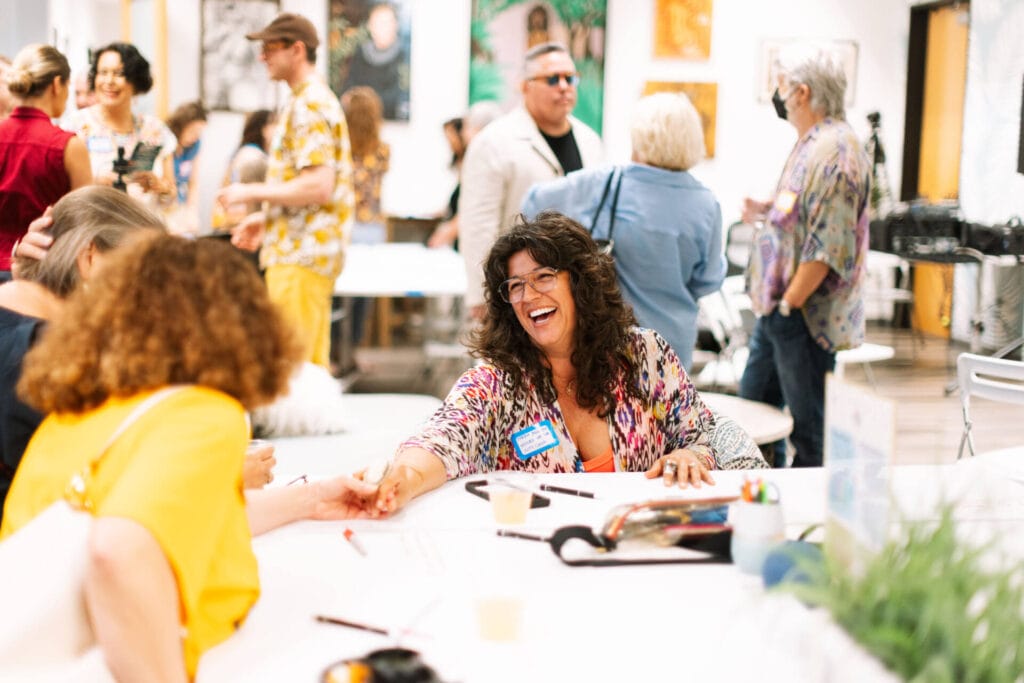
Much like Vanguard Culture in San Diego, artists and art organizations are getting to know one another and now—for the first time—covering each other’s events. Very few organizations are acting out, forming coalitions to be heard.
According to Zachary Small, of The New York Times, “Dozens of prominent artists and organizations, known collectively as Fall of Freedom, have signed on to participate in a series of artistic demonstrations aimed to protest what they see as authoritarian overreach by the Trump administration and its allies.”
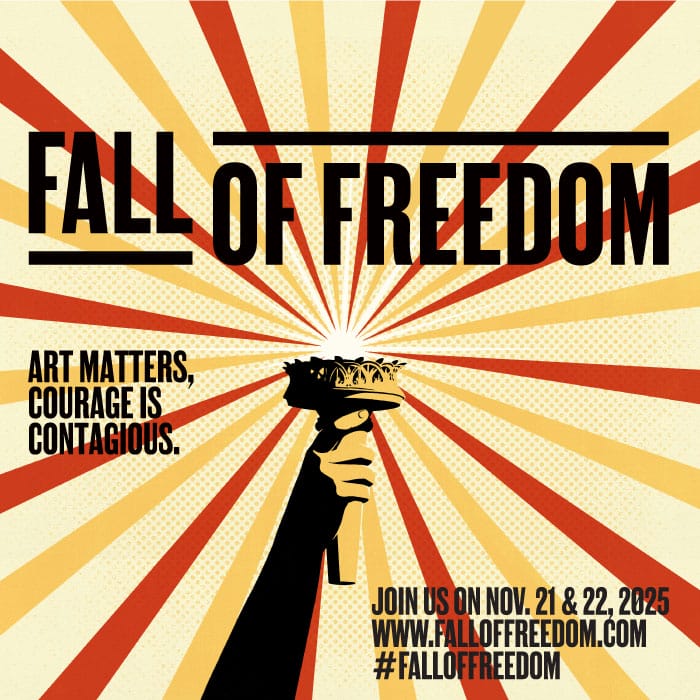
Their call to action—“an urgent call to the arts community to unite in defiance of authoritarian forces sweeping the nation”—is both moral and artistic. It is not about partisanship; it is about principle. It is about whether truth, imagination, and dissent will still have a place in the American public square.
As Zachary Small reported in The New York Times, the coalition includes not only painters, filmmakers, and musicians, but also cultural institutions like the Brooklyn Public Library, Dallas Contemporary, and Woolly Mammoth Theatre Company in Washington, D.C. Together, they are reminding the country that art has always been a mirror of freedom—and that when art is threatened, democracy itself is in peril.
Among the most visible leaders are Dread Scott, the visual artist known for confronting America’s legacy of racism, and Lynn Nottage, the Pulitzer Prize–winning playwright whose work has long examined injustice and inequality.
The warning signs have been accumulating. In recent months, members of the Kennedy Center Board of Trustees and the President’s Committee on the Arts and the Humanities have resigned en masse, citing irreconcilable differences with the administration’s disregard for democratic norms.
Funding for the National Endowment for the Arts and the National Endowment for the Humanities—tiny investments relative to the federal budget, but enormous symbols of cultural values—has been gutted. Programs designed to bring art and music to underserved communities have been eliminated. Exhibitions have been canceled.
Even the Federal Communications Commission has entered the fray. “We can do this the hard way or the easy way,” the FCC chair warned on national television—an astonishing statement in a democracy that depends on a free press. Formal investigations have since been launched into major broadcast networks, including NPR.
What these protests represent is not just anger at a single administration, but a larger struggle for the idea of America itself—the belief that democracy requires not obedience but participation, not silence but speech, not conformity but imagination.
The protests are growing because Americans know this instinctively: democracy dies not with a bang but with a whisper—with the quiet closing of a gallery, the silencing of a journalist, the shuttering of a theater, the self-censorship of an artist afraid to offend.
That is why the artists are rising.
That is why the people are marching.
And that is why this moment matters.
Because this is not just about art—it is about freedom. And this, as the artists remind us, is only the beginning.