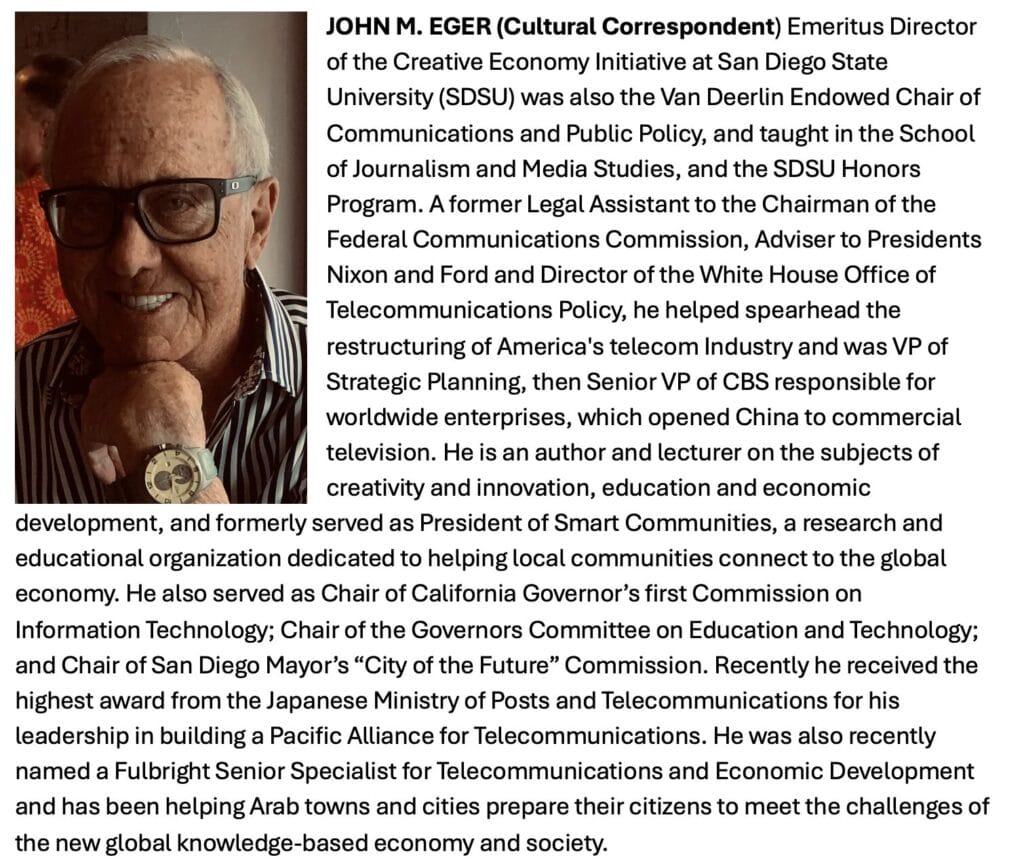

by John M. Eger
November 20, 2025
Think about it.
One of the first questions every college student gets asked by relatives, neighbors, or even strangers is: “So, what’s your major?” If the answer is business, petroleum engineering, or computer science, the assumption is: Good choice. That will lead to a high-paying job.
The bigger question—What should I major in?—looms over every student and every parent. Society piles on expectations, measuring worth by whether a degree seems “practical.” Most families still push their children toward technical fields, imagining that’s the surest path to security.
But here’s the truth: it probably doesn’t matter.
For one, most college graduates have jobs unrelated to their major, according to one major study by the U.S. Census Bureau; most graduates are working in jobs totally unrelated to their major.
Why?
Because the world doesn’t work like that anymore. The amount of new technical information doubles every two years. For students in a four-year technical degree program, half of what they learned in their first year may already be outdated by the time they’re juniors. Technical expertise is essential, yes, but by itself it’s no longer enough.
What matters more is learning how to learn. Developing the ability to adapt, to reframe problems, to draw connections across disciplines, and to think creatively about the future. This is the fundamental truth of the new economy. And it’s why art, design, and creativity are no longer “luxuries” on the edge of education—they are central to survival.
The New Role of Creativity
Creativity is not simply about painting or music; it’s about imagination, synthesis, and innovation. It’s the spark that allows engineers to design human-centered technology, entrepreneurs to reimagine markets, and communities to solve complex social problems. It’s the bridge between disciplines that helps people see the forest and the trees.
Whole-brain thinking—combining logic with imagination, analysis with intuition—is becoming the most valuable skill of all. And universities are slowly catching on.

Where It’s Happening Now
- Aalto University (Finland): At the Design Factory, engineering, art, and business students come together not to sit in classrooms, but to design, build, and market real innovations. The boundaries between disciplines blur—and that’s where creativity flourishes.
- Stanford’s d.school (USA): A hub for “design thinking,” the d.school invites students from medicine, law, engineering, and the arts to tackle messy, real-world problems using empathy, storytelling, prototyping, and collaboration.
- Singapore’s STEAM Movement: The city-state has embraced not just STEM (science, technology, engineering, mathematics) but STEAM—adding the “A” for art—to foster creative industries, from game design to green architecture.
- Ashoka University (India): Known as the “Ivy League of Liberal Arts” in India, it deliberately breaks away from narrow specializations, requiring students to explore literature, history, philosophy, and art alongside economics and computer science.
These examples show what’s possible when creativity is treated not as an extracurricular, but as the foundation of an education.
The Future of the University
The university of the future should not lock students into rigid majors or train them for a single career that may disappear within a decade. Instead, it should:
- Offer interdisciplinary learning that draws from art, science, business, and community.
- Encourage real-world projects where students practice solving problems, not just memorizing answers.
- Prioritize learning how to learn—equipping students with curiosity, resilience, and adaptability.
- Place art and creativity at the center of education, not at the margins.
The major may still serve as a guidepost, but it should never be a prison. What students really need is freedom—the freedom to explore, to combine, to imagine, and to build.
Because in a rapidly changing world, degrees are not enough. Creativity is the currency of the future.