
By Cory-LaNeave Jones
August 18, 2025

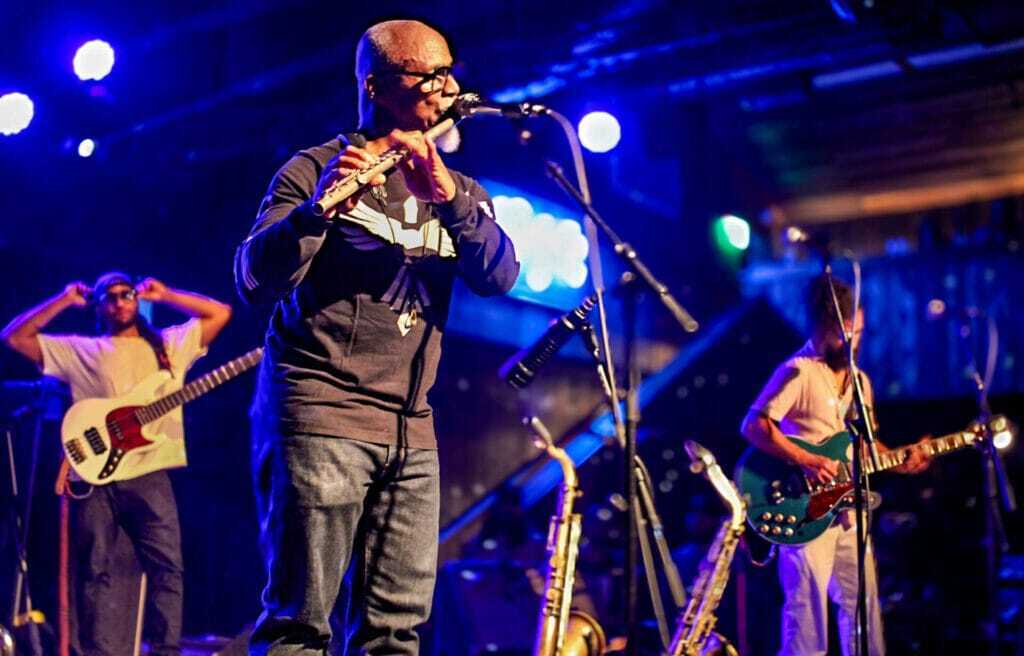
The first thing you notice about Karl Denson is not the horn, or the flute — though they sit near him like tamed animals — but the way he bolts into your presence with both power and a calm collected air of unquestioned wisdom in the melodic arts. In the busy back room of the performance space, between the clink of coffee cups and the hum of an amplifier, he is focused on the work ahead, unloading the amplifiers and musical instruments off the truck. He is a man that has worked his whole life and is not going to let any young whipper snappers show him how to do the work he has done since before they were in diapers. He had only a few minutes to chat on the phone before sound check, but that was enough time for me to get a sense of who the man is.
We talked about Southern California in the 1900’s, as if it were a kind of long bridge between oceans: the salt air carrying James Brown through transistor radios, the low thump of Sly and the Family Stone rolling through open windows, the desert heat pressing in from the east. He talks about his love of jazz greats learning from other talented artists as he came up through the ranks.
Denson has moved through more than four decades of American music with an unhurried gait, even when the tempos ran hot. He’s played to millions as part of the Rolling Stones’ touring band, and to hundreds in cramped clubs like he did with Karl Denson’s Tiny Universe (KDTU) at the Belly Up Tavern in Solana Beach. KDTU is his own shape-shifting, genre-bending project. His saxophone voice carries something of that California coastline—briny, elastic, refusing to break—and something harder, a tone forged on the road, where soundchecks blur into border crossings and into the moment when the lights go down.
This past weekend in Solana Beach, the questions began where most stories begin—with the weather, the neighborhood, the first thing you remember hearing—and moved outward, through the calm cool waters and the machinery of fame, into the private, sometimes wordless territory where music is less a profession than a calling. The show on Friday evening August 15, 2025 shot out the gate, with the blurring blues riff’s of Fallbrook’s own virtuoso guitarist, Anthony Cullins ripping up the stage summing up his own best impressions of a bit of Buddy Guy, Stevie Ray Vaughn, Freddie King, a little Billy Gibbons and Joe Bonomassa.
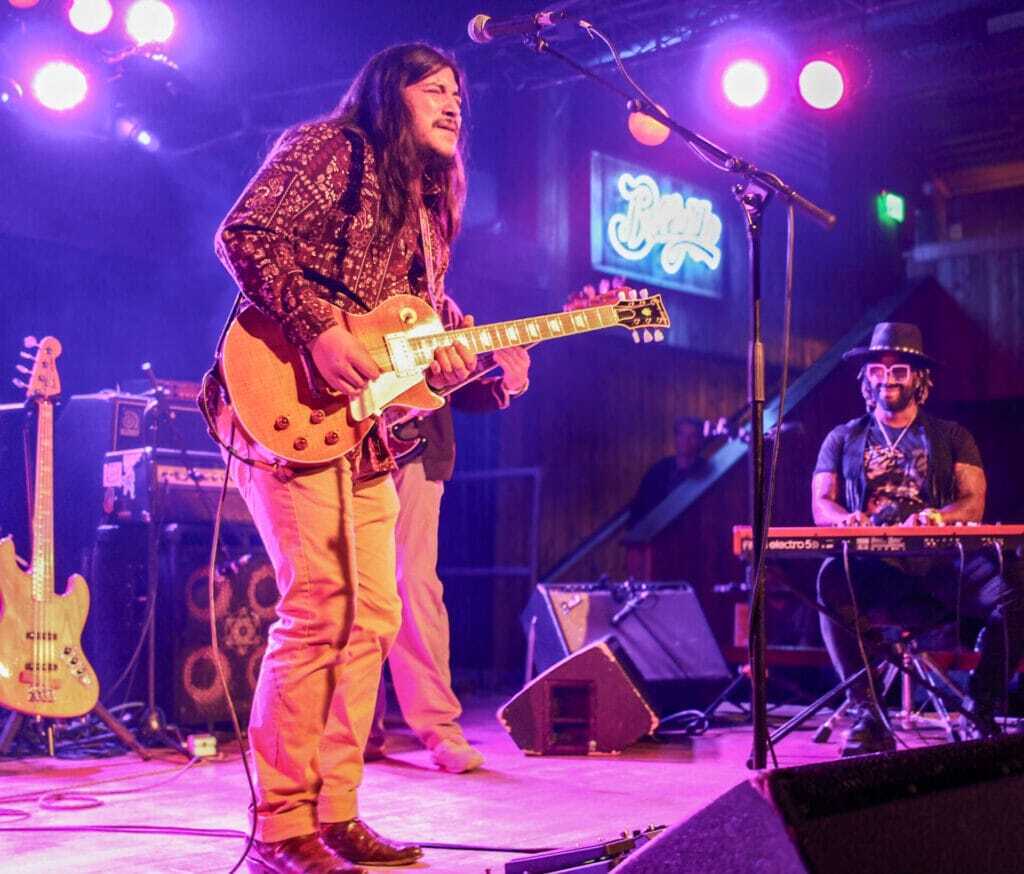
Anthony has been at it since the age of 14 in 2015, when he was billed as “The Fallbrook Kid.” Now, a decade in, he has continued to rock venues both big and small, often backed by a rocking drummer, Carson Ford, a smooth chill-vibes bassist, Kyre Wilcox, and some jazzy licks by his keyboardist, Noah Williams.
Karl Denson’s Tiny Universe, or just KDTU for short, is a contradictory name, since most of us used to all to agree that the Universe is ever expanding. Nonetheless, this band of musicians is anything but tiny. They present as Big, Beautiful Sounds, Harmonies, and Rhythms, they represent multiple musical lexicons, and they exploit your inability to resist moving your body to the motion-inducing thing we call dance.
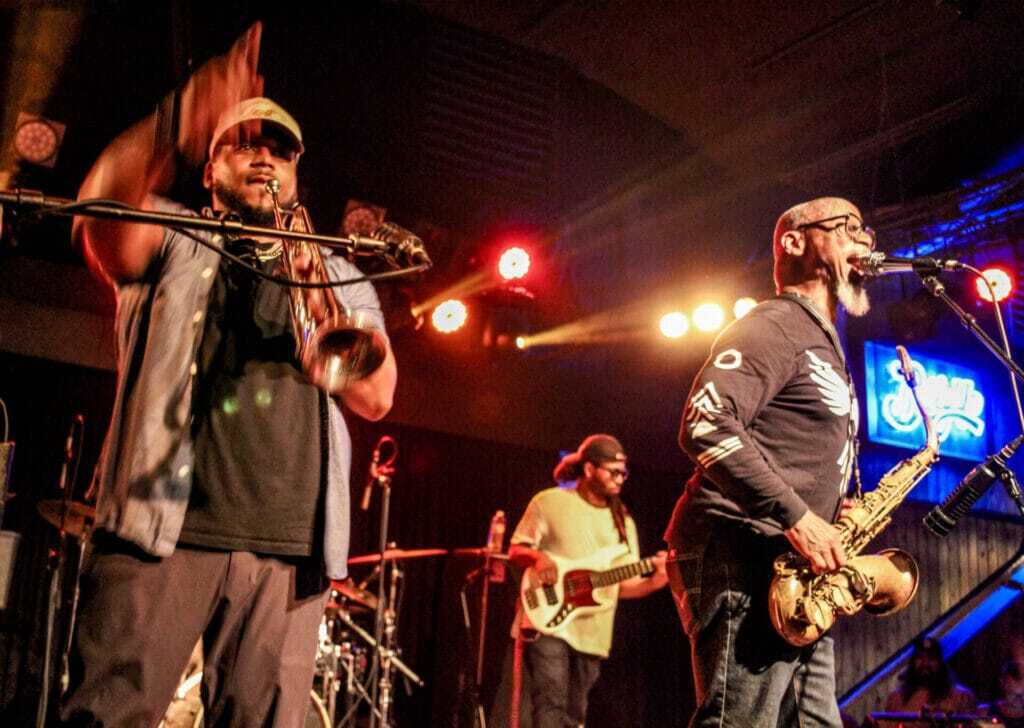
I had the chance to speak with Karl Denson before the show and here’s how it went.
Cory
Originally, it looked like maybe you were born in Santa Ana, but did you grow up in San Diego proper?
Karl
No, no, I grew up in Orange County. I’m a pure Southern Californian, not a pure San Diegan.
Cory
Thanks for clarifying. All right. Well, they’re similar locations in a lot of ways, and so I was wondering when you think back to your early childhood and growing up, and I assume in the seventies and eighties, what sounds do you think influenced your sound? Was it street sounds, church choirs, basketball courts? I don’t know. Was it Coltrane, Mingus, Monk, or maybe radio static?
Karl
The latter. It was definitely Coltrane, Mingus, Monk, Yusef Lateef, David ‘Fathead’ Newman, Eddie Harris, I was hearing. And then a healthy smattering of James Brown and Sly and the Family Stone along with that.

Cory
So then were you listening to those tunes on vinyl, or on the radio, or all of the above?
Karl
Yeah. I’m an analog kid.
Radios. I had older brothers and sisters, which was really fortunate, and so I got to hear things before I would’ve naturally got to them.
I remember hearing that song, Iko Iko, we didn’t have any relationship to New Orleans, but my sister, my oldest sister got that 45 by The Dixie Cups. That’s one of my first memories of seeing a record and hearing it being like, “Oh, what is that? That’s kind of dope.”
Cory
Yeah. That’s cool. So, when did you start learning to play saxophone and flute?
Karl
Seventh grade.
Cory
All right. So, you started in the school band?
Karl
Yeah.
Cory
Growing up near the ocean, do you find that your playing absorbed a certain looseness of wave-like flow, or is that just like a romantic projection of ordinary people?
Karl
It is exactly that (a projection). Okay. I definitely know there’s a laid back-ness, a certain vibe to Southern Californians, that I definitely have, and recognize in other people. When I do meet Southern Californians, we gravitate to each other because of that, but musically, it was not really something that I tried to project.

Cory
Okay. So, I was looking through your playlist on Spotify and listening to some of your earlier tunes, and I noticed early on you were doing more straight jazz sounding albums, and there was also another thing that popped out to me. There’s a lot of references to food, so I don’t know how much food is a method, or a means, to finding artistic creativity for you. In ‘91, you had Blackened Red Snapper, and in ‘92, you had Herbal Turkey Breast, and that had some Goodbye Pork Pie Hat. You had a Chunky Pecan Pie in ‘94 with Fried Bananas, Blue-Eyed Peas, Banana Boy, and an album titled Baby Food in ‘95. So yeah, I just didn’t know how central eating good food is to your process.
Karl
Yeah. It’s pretty central actually. My next (thing I’m producing) on the interweb is going to be. We just did our second episode of “Cooking for Ricky,” who’s my guitar player.
Him and his editor Jordan come over and film me, and I make meals for them. So yeah, it’s pretty seminal.
Cory
Very cool.
Karl
My mom was a really great cook, and my family, we have serious traditions of food.
Cory
You guys throw down.
Karl
Yeah.
Cory
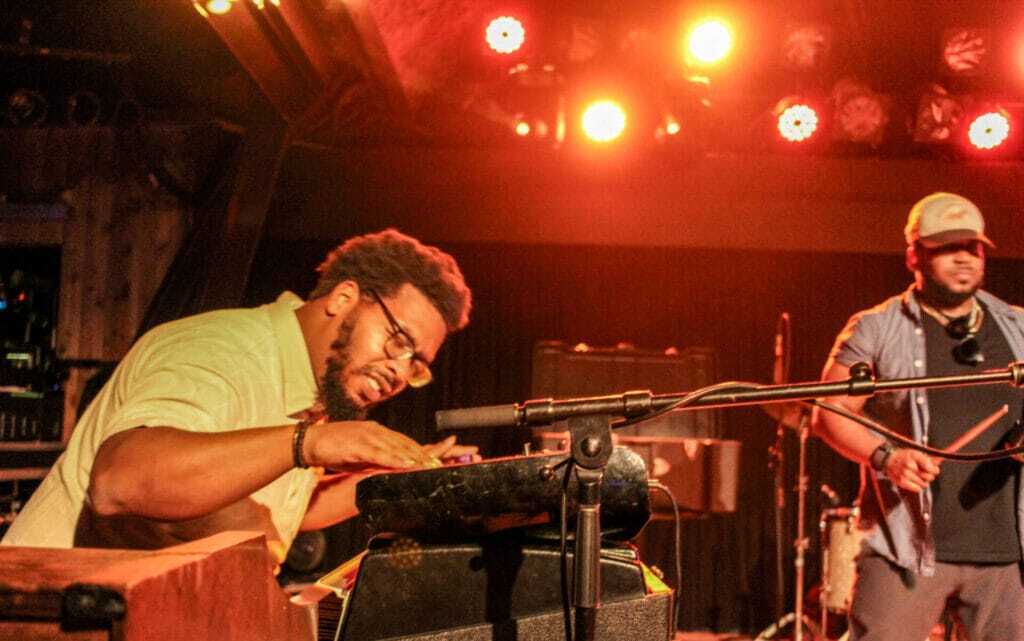
I feel that. All right, so I noticed in the next album I saw “Dance Lesson No. 2” in 2000. There was an incorporation of hip hop scratching along with more funk rhythms and some of those rhythms reminded me a lot of Booker T. & the M. G.s. In that Dance Lesson No. 2 song, there’s this supremely quick transition from flute to sax. It’s like a quarter or a half step, and I didn’t know if that’s all you, or if that’s just (done in the studio), that transition from flute to saxophone. It was so quick. I was like, all right!
Karl
Oh, well, that’s a record. Lenny Kravitz taught me – one of the things I kept, from Lenny, is when you make a record, you make a record. When you go play live, you play live.
Cory
I was trying to envision, you have a flute strap so you can throw the flute down real quick and grab your sax.
Karl
No, you’d have to see it live and figure it out how quick I can do it. I can do it pretty quick, but I don’t think it’s that fast.
Cory
It kind of reminded me of some blues guitarists (I was trying to think of Buddy Guy), that do all those guitar tricks like playing between their legs and behind their back and stuff.

Cory
Alright, so in 2005, then you laid down some tracks on Soul Summit at Berk’s Jazz Fest, and that included a live version of Chicken and Waffles. Just saying, but whose chicken and waffles do you prefer the best: yours or Roscoe’s or are there any spots down here in San Diego or maybe your mom’s?
Karl
Actually, I prefer mine.
I’m not sure. I might still prefer Roscoe’s than mine. I don’t really like fried chicken that much.
I prefer like a baked chicken.
And that’s how I do mine. But Roscoe’s waffles are pretty superior, but mine are healthier.
Cory
I was going to hit you up for that breading recipe if you got one that’s solid. How you bread your chicken.
Karl
That’s our first episode of “Cooking for Ricky,” it’s Chicken and Waffles.
So that’s going to be coming soon.

Cory
Awesome. So you also, you move between worlds from film sets with Eddie Murphy and then on the road with The Rolling Stones and in clubs in your own band KDTU. How does a musician learn to shapeshift without losing his core?
Karl
It’s not really shapeshift.
The Eddie Murphy thing – that’s just a fleeting thing that happened, has really no bearing on my life in any way. The Rolling Stones, I was kind of ready for that. That was something that I prepared for – (pause) unconsciously – because I became a Bobby Keys fan early on when I was probably 19, 20 years old. People would mention him, and I didn’t know who he was, and so I searched him out, and this was before the internet, so you had to actually do some work.

But I discovered who Bobby Keys was and realized that I already kind of knew him and liked him. I liked the Rolling Stones, so it was just over the years, I referred to him for a certain kind of style that just made sense to me.
Cory
Did you consider yourself, were you kind of a session player, for a while because it looked like there were a lot of other folks tracks you were working with?
Karl
I was not really a session player. I wasn’t great in the studio. I’d never been great in the studio. A little too self-conscious to be amazing in the studio, and I always wanted to be my own writer. I feel like that was always what I was more focused on, what my energy was, writing.
Cory
Then you also, you did some stuff with Steve Winwood. I don’t know, did Chaka Khan introduce you two, or how did that come about?
Karl
Oh, no, that was through the Madison House people, ah, you know String Cheese (Incident). Their management, they worked with Steve Winwood for a little while, and through them I met Steve and got to be on his record.
Cory
Then did you have a similar relationship to meeting up with Lenny as well?
Karl
Lenny I met through a friend who lived in LA. Just things kind of materialized when I was just working and hammering nails, and Lenny was one of those things. I met him in ‘86 probably. I did some studio work for him, and then when he went to New York, married Lisa [Bonet] and was working on his solo career, he called me and my friend Mike Hunter, and we came to New York and that was the beginning of it.
Cory
Yeah. I mean, I love the Let Love rule vibe.
Karl
Yeah. That’s a great record.
Cory
What’s the most dangerous thing you’ve ever done in service of your music? Not physically dangerous, but maybe dangerous to your sense of safety or your artistic comfort zone?
Karl
Start singing.
Yeah. That was definitely a step out of my element in a way. I always kind think of myself as a vocal writer, but to be a full-time singer, that was not what I envisioned.
Cory
Do you at all feel like the wind instruments were more of a mask to you unveiling yourself in your singing?
Karl
No, it’s just not something that I planned on doing really. I never thought about it in that way. I’m not a natural singer. People who sing, who have those voices that open their mouth and they have a great voice, so I’ve had to become more of a stylist. I’m more like a Bob Dylan.

Cory
How do you reconcile the intimacy of jazz improvisation versus an arena show? Do you find one to be more honest, or is that a false dichotomy?
Karl
Yeah, I mean, you’re just playing music, man. At the end of the day, you’re just trying to play the right notes all the time.
It’s like a puzzle that you’re just trying to get it correct.
Cory
I was watching Quest Love’s documentary on Sly Stone last night. “Sly Lives!” on Hulu and it’s a pretty darn good documentary. So, he was asking all these people this question I wanted to ask you, is there a burden on Black Genius?
Karl
There’s a burden on Black. I have a song on my new record called Just Be Black, and it’s just living in the world. There’s a definite challenge to just living and being black and having to deal with basically white supremacy. Whether it’s benevolent or malicious, it’s always there and we’re seeing the fruits of that right now, so, it’s just hard.
Cory
Thanks for your time.
Karl
My pleasure, man.
Cory
Yeah, break a leg tonight.
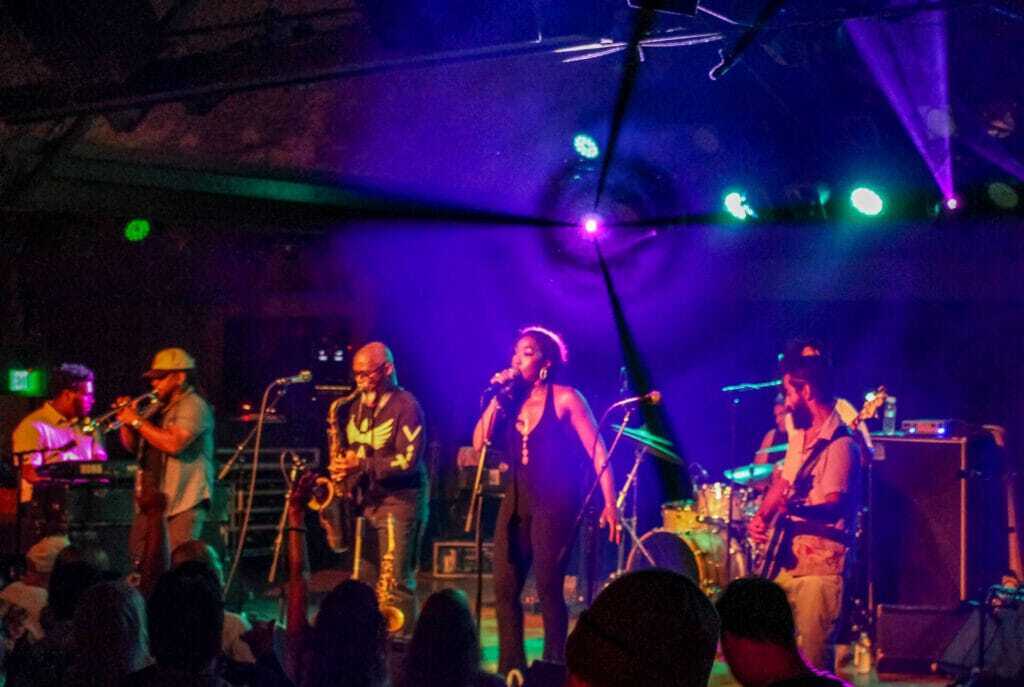
I had a great time re-visiting this venue, one of my old stomping grounds when I was a simple ticket sales and merchandise clerk. I learned a little about the business of the music industry in those years. The importance of ticket sales to support the kitchen staff, waiters, security, and ticket staff as well as the artists. I was able to catch up with my favorite managers, Steve Roder and Gasper Ferrara.
Thanks to Karl’s team who all assisted with the interview, including Kevin Calabro, Erik Newson, Lee Frank, and Derrick Parker. I was able to get assistance from the wonderful person I used to report to, Iris Alvarez. She’s great at getting things done. And familiar faces from the old days. Don’t forget to tip when you visit. Working for tips is something many artists understand is a necessity in the US.
Karl Denson’s Tiny Universe played two sets at the Belly Up in Solana Beach on Friday and Saturday, August 15 and 16, 2025. The Belly Up is located at 143 S. Cedros Avenue, Solana Beach, CA 92075.
Visit https://bellyup.com/ to follow for upcoming shows.
A cautionary note from someone who used to work there:
Make sure you purchase tickets through their website, a lot of third party vendors sell tickets that may not be official tickets and you may not gain entrance to shows if you use a third party sales website.